
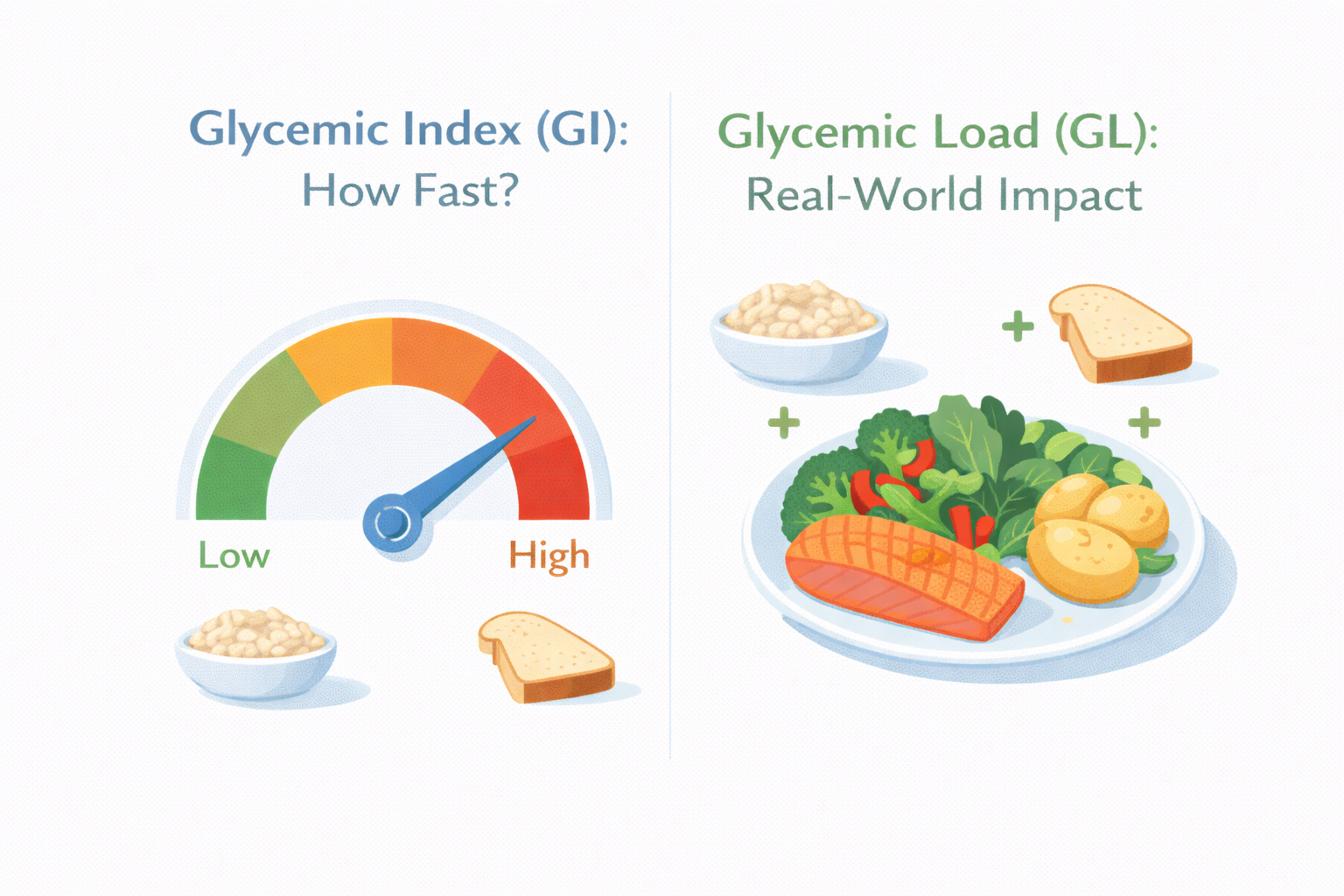
The glycemic index and glycemic load show you something carb counting alone can’t — not just how much carbohydrate you’re eating, but how fast and how significantly it’s likely to raise your blood sugar after a meal. For people managing diabetes, that extra layer of information can mean fewer post-meal spikes, steadier energy, and smarter food choices every day.
This guide explains what GI and GL mean, walks through GI values for dozens of common foods, and shows you how to use both tools practically alongside your existing meal plan.
Searching for a specific answer? Jump to our Frequently Asked Questions for quick answers about the glycemic index and glycemic load.
| Concept | What It Measures | Low / Med / High |
|---|---|---|
| Glycemic Index (GI) | How quickly a food raises blood sugar vs. pure glucose | Low ≤55 / Med 56–69 / High ≥70 |
| Glycemic Load (GL) | Blood sugar impact of a real-world serving size | Low ≤10 / Med 11–19 / High ≥20 |
Key takeaway: GI and GL work best alongside, not instead of, carb counting, portion control, and your own glucose data.
What do you need to know about GI and GL? (Quick Summary)
- The glycemic index (GI) shows how fast a carbohydrate-rich food raises your blood sugar compared to a reference food.
- Glycemic load (GL) factors in portion size and grams of available carbohydrate, making it more useful for practical meal choices.
- GI and GL can help refine your carb counting, but they do not replace total carbohydrate counting, portion control, or personalized glucose monitoring.
- Food processing, ripeness, cooking method, meal composition, and your personal response can all influence the actual rise in your blood glucose.
What is the glycemic index (GI)?
Not all carbs are equal. Although nearly all carbohydrates (except fiber and some sugar alcohols) eventually convert to blood glucose, some do so much faster than others. The glycemic index ranks carbohydrate foods by how quickly they raise blood glucose levels after eating. GI reflects carbohydrate quality — the speed — not the total amount of carbohydrate consumed. Essentially, GI shows the percentage of carbohydrates that enter the bloodstream as glucose within the first two hours.
GI values are typically categorized as low (55 or less), medium (56–69), and high (70 or more) on the glucose = 100 scale.
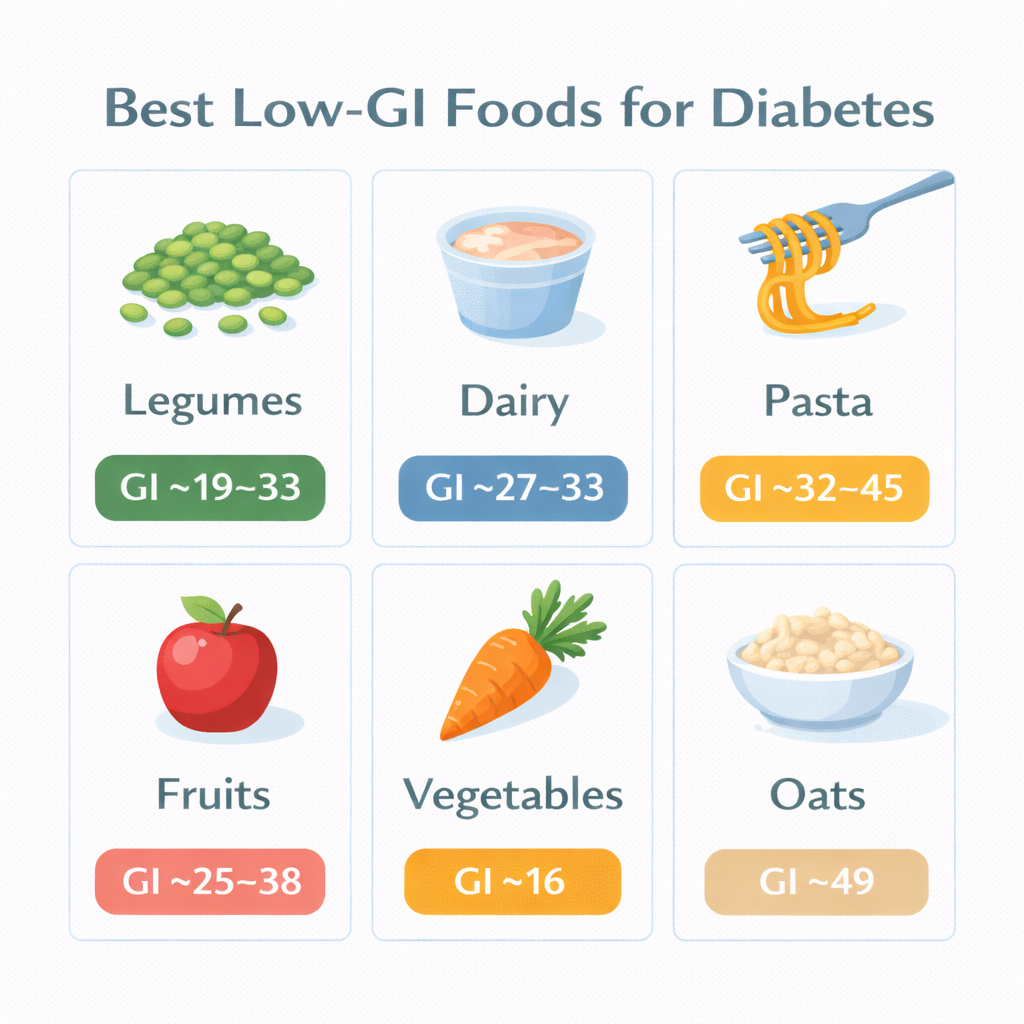
Examples often found in lower-GI groups include legumes, many fruits, yogurt, and various pasta products. Higher-GI foods usually include white bread, many breakfast cereals, pretzels, and most potatoes. However, GI can vary greatly depending on brand, variety, and preparation method. Check out these examples:
Breads & Crackers
| Food | GI |
|---|---|
| Bagel | 72 |
| Croissant | 67 |
| Graham Crackers | 74 |
| Saltine Crackers | 74 |
| Wheat Bread | 68 |
| White Bread | 71 |
Cakes, Cookies & Candy
| Food | GI |
|---|---|
| Blueberry Muffin | 59 |
| Chocolate Cake | 38 |
| Donut | 76 |
| Jelly Beans | 80 |
| Oatmeal Cookies | 55 |
| Vanilla Wafers | 77 |
Cereals & Breakfast Foods
| Food | GI |
|---|---|
| Bran Chex | 58 |
| Cheerios | 74 |
| Corn Flakes | 83 |
| Cream of Wheat | 70 |
| Grape Nuts | 67 |
| Oatmeal | 49 |
Combination Foods
| Food | GI |
|---|---|
| Chicken Nuggets | 46 |
| Fish Fingers | 38 |
| Gatorade | 78 |
| Macaroni & Cheese | 64 |
| Pizza (cheese) | 60 |
Dairy
| Food | GI |
|---|---|
| Chocolate Milk | 34 |
| Ice Cream, vanilla | 62 |
| Milk, skim | 32 |
| Milk, whole | 27 |
| Yogurt, low fat | 33 |
Fruits & Juices
| Food | GI |
|---|---|
| Apple | 38 |
| Apple Juice | 41 |
| Banana | 55 |
| Grapefruit | 25 |
| Grapes | 46 |
Legumes
| Food | GI |
|---|---|
| Baked Beans | 48 |
| Black-eyed Peas | 42 |
| Chickpeas | 33 |
| Peanuts | 15 |
| Red Kidney Beans | 19 |
Grains & Pasta
| Food | GI |
|---|---|
| Fettuccini | 32 |
| Linguini | 55 |
| Macaroni | 45 |
| Ravioli | 39 |
| Spaghetti | 41 |
Snack Foods
| Food | GI |
|---|---|
| Corn Chips | 74 |
| Granola Bars | 61 |
| Popcorn | 55 |
| Potato Chips | 54 |
| Pretzels | 81 |
Soups
| Food | GI |
|---|---|
| Black Bean | 64 |
| Lentil | 44 |
| Minestrone | 39 |
| Split Pea | 60 |
| Tomato | 38 |
Vegetables
| Food | GI |
|---|---|
| Carrots, raw | 16 |
| Corn | 46 |
| French Fries | 75 |
| Peas | 48 |
| Potato, baked | 85 |
What is glycemic load (GL) and why does it matter?
GI alone can be misleading because it doesn’t account for portion size. Glycemic load (GL) addresses this by combining GI with the amount of available carbohydrate in a typical serving.
Formula: GL = (GI × grams of available carbohydrate in the serving) / 100
A food can have a high GI but a low GL if the typical serving contains little available carbohydrate — such as some fruits with high water content. That’s why GL is often more useful for everyday meal planning. Common GL categories for a serving are low (10 or less), medium (11–19), and high (20 or more).
How do GI and GL enhance carb counting?
Carb counting shows how much carbohydrate you’re consuming. GI and GL give context about how quickly and how much that carbohydrate might affect your blood sugar levels — which is especially useful when you’re reviewing post-meal patterns on a continuous glucose monitor (CGM).
In practice, many people find they succeed best by combining:
- Total carb awareness — how many grams you’re consuming
- Food quality — fiber content, processing level, and GI/GL
- Protein and fat balance — both slow the blood sugar rise when eaten with carbs
- Tracking individual glucose patterns — using a CGM or post-meal checks
What changes a food’s GI in real life?
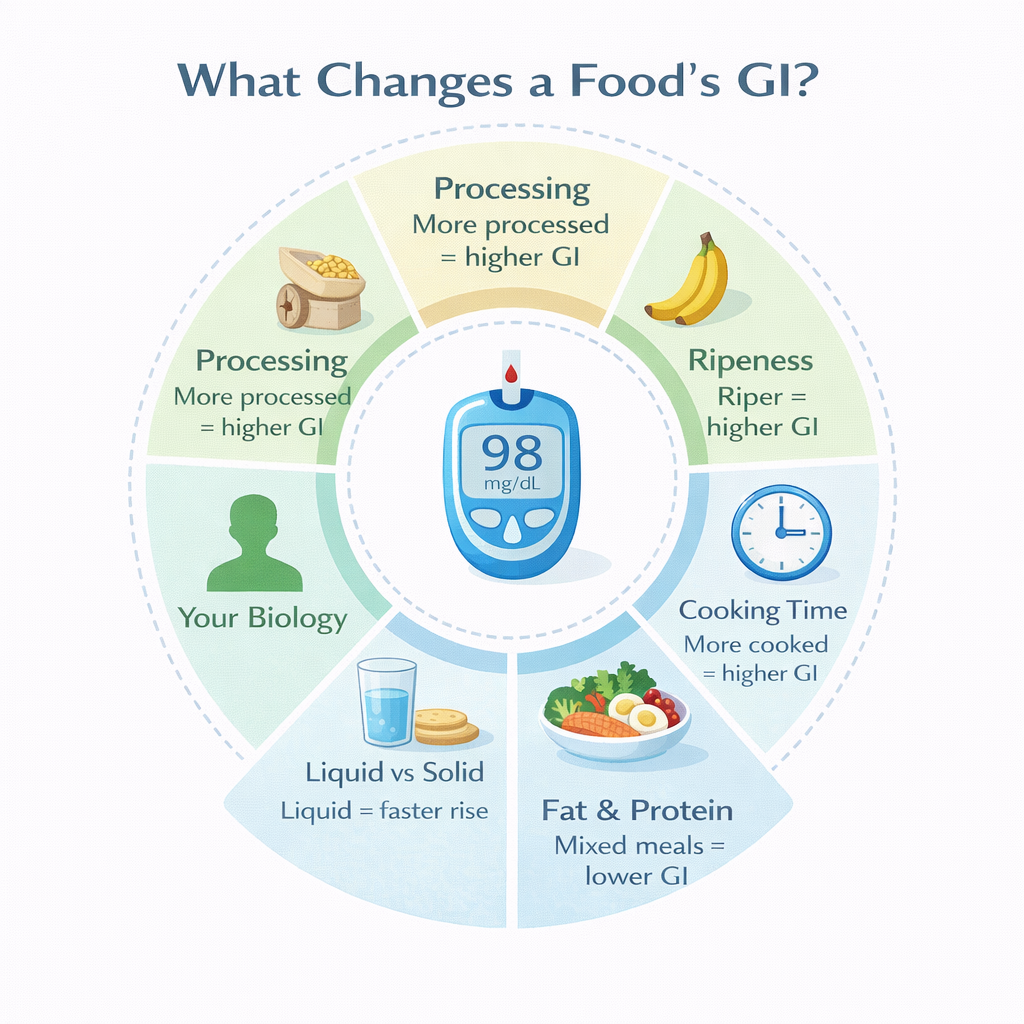
Published GI values are measured under controlled conditions — but real eating is far less predictable. Several factors can raise or lower how a food actually affects your blood sugar:
- Particle size and processing: Whole grain vs. finely milled flour — the more processed, the higher the GI tends to be.
- Ripeness: Bananas can have a higher GI as they ripen, as starches convert to sugars.
- Cooking method and time: Al dente pasta has a lower GI than the same pasta cooked until soft.
- Temperature and reheating: Cooling starchy foods (rice, potatoes, pasta) can lower their effective GI by creating resistant starch.
- Fat, protein, and fiber eaten with the carbohydrate: Mixed meals behave very differently from single foods tested in a lab.
- Liquid vs. solid form: Liquids — including juices and smoothies — generally raise blood sugar faster than solid food.
- Individual factors: Digestion, insulin sensitivity, activity levels, stress, and time of day all play a role in your personal response.
What are the strengths and limits of GI and GL?
| Helpful Uses | Important Limits |
|---|---|
| Compare similar foods (e.g., one bread or cereal vs. another) | Does not replace portion size or total carb counting |
| Choose foods that may cause slower post-meal blood sugar rises | Values vary by brand, recipe, and preparation method |
| Support satiety and higher-fiber food choices | Mixed meals can behave differently than single foods |
| Guide food experiments using a CGM or glucose checks | Individual responses may differ significantly |
What are practical tips for using GI and GL with diabetes?
- Start with the basics: Consistent carbohydrate intake, enough protein, high-fiber foods, and mindful portion control are the foundation. GI and GL layer on top — they don’t replace it.
- Compare within categories: Use GI/GL to choose between similar options (e.g., one breakfast cereal vs. another), not as the only rule for every food decision.
- Choose minimally processed carbs more often: Beans and lentils, intact whole grains, unsweetened yogurt, and whole fruits are naturally lower GI and higher in fiber.
- Watch your own response: A CGM or a 1–2-hour post-meal blood sugar check can reveal whether a particular food affects you differently than published values suggest.
- Talk with your care team about insulin timing: GI can influence when to take rapid-acting insulin before a meal, but the safest approach is personalized — based on your typical meal patterns, current blood sugar, and risk of going too low.
GI and GL are helpful tools, but they are only part of diabetes nutrition planning. Current guidelines focus on personalized eating patterns, nutrition quality, and sustainable habits rather than relying solely on a single system.
Current food databases are more comprehensive and precise than early GI literature, but values still vary. Whenever possible, use reputable GI/GL databases alongside your own glucose data.
When are GI and GL most useful for diabetes management?
- Post-meal blood sugar spikes despite accurate carbohydrate counting
- Comparing packaged carbohydrate foods with similar carb counts
- Adjusting meals around exercise or endurance activities
- Planning snacks that are less likely to cause rapid blood sugar highs and crashes
What’s the bottom line on glycemic index and glycemic load?
Use the glycemic index and glycemic load as practical tools alongside carb counting — not as replacements for it. The most effective approach is personalized: choose nutrient-rich carbs, manage portion sizes, pair carbs with protein or fiber, and use your own glucose data to find what works best for you.
Looking for an easy reference tool? The Glycemic Index plus Load App from Glycemic-Index.Net is free and includes ratings for over 500 foods.
Helpful Resources & Research
- ADA Standards of Care in Diabetes – 2026 (nutrition and health behavior guidance; living guideline)
- New England Journal of Medicine: Glycemic Index, Glycemic Load, and Cardiovascular Disease and Mortality
- University of Sydney / SUGiRS GI Database and GI Search
- Diabetes Canada Glycemic Index Food Guide (PDF)
- University of Washington Guide to the Glycemic Index (PDF)
- Mayo Clinic: Low-Glycemic Index Diet – What’s Behind the Claims (updated 2025)
- Atkinson FS, Foster-Powell K, Brand-Miller JC – International Tables of GI and GL Values (AJCN, 2021 update)
- Jenkins DJA et al. – Original glycemic index research and subsequent clinical literature on post-meal blood sugar response.
Note: This article is for educational use only and does not replace personalized medical advice.
Frequently Asked Questions
What is the glycemic index and why does it matter for diabetes?
The glycemic index (GI) ranks carbohydrate foods from 0 to 100 based on how quickly they raise your blood sugar after eating, compared to pure glucose. Foods with a GI of 55 or below raise blood sugar slowly, helping you avoid big spikes after meals. For people with diabetes, choosing lower-GI foods more often — alongside carb counting and portion control — can make blood sugar easier to manage day to day.
What is glycemic load, and how is it different from GI?
Glycemic load (GL) builds on the glycemic index by factoring in the actual amount of carbohydrate in a typical serving. A food can have a high GI but still cause only a modest blood sugar rise if the portion is small — watermelon is a classic example. GL is calculated as (GI × grams of available carbs) ÷ 100, and a GL of 10 or below per serving is considered low.
What are the best low glycemic index foods for diabetes?
Some of the most reliable low-GI choices include legumes (lentils, chickpeas, kidney beans), most whole fruits, dairy products like plain yogurt and milk, pasta cooked al dente, and oatmeal. These foods raise blood sugar more slowly because their structure slows digestion, and they’re also generally higher in fiber — a double benefit for blood sugar management.
Can I use GI and GL instead of counting carbs?
No — GI and GL are best used alongside carb counting, not as a replacement. Carb counting tells you how much carbohydrate you’re eating, which is essential for insulin dosing. GI and GL tell you how fast and how significantly those carbs may raise your blood sugar. Together, they give you a more complete picture than either approach alone.
What changes a food’s glycemic index in real life?
Many things can raise or lower a food’s actual blood sugar impact: how finely the grain is milled, how ripe a fruit is, how long food is cooked, whether it’s eaten hot or cold, and what else is on the plate. Adding protein, fat, or fiber to a carbohydrate-rich meal consistently lowers the meal’s combined GI. Individual factors, such as digestion speed and insulin sensitivity, also play a big role.
Will a high-GI food always spike my blood sugar?
Not necessarily. Portion size (glycemic load), what else you eat with it, and your own biology all affect the real-world outcome. A small amount of a high-GI food may cause only a modest rise. Eating a high-GI food alongside protein, fat, or fiber significantly slows digestion and lowers the blood sugar response. The best way to know is to check your own post-meal readings.
How can a CGM help me use the glycemic index more effectively?
A continuous glucose monitor (CGM) shows you exactly how your blood sugar responds to specific foods — which can differ from published GI values due to cooking method, portion size, meal composition, and your individual biology. You can run simple personal experiments: eat two similar meals with different GI profiles and compare the blood sugar curves. This turns general GI guidance into personalized, actionable data.
What blood sugar level is a good result two hours after eating?
The ADA 2026 guidelines suggest a target below 180 mg/dL (10.0 mmol/L) at 2 hours after the start of a meal for most people with diabetes — though your personal target may be different. A rise of less than 40 mg/dL (2.2 mmol/L) above your pre-meal level is generally considered a modest post-meal response. Always confirm your individual targets with your diabetes care team.
Are published GI values accurate for every food?
GI values are a useful guide, but not an exact prediction for every person or situation. Testing is done in controlled settings on groups of people, and values can shift based on brand, ripeness, cooking method, and individual biology. Use reputable databases like the University of Sydney’s GI database as your reference, and always pair that information with your own glucose readings for the most reliable picture.
What do current diabetes guidelines say about using GI and GL in 2026?
The ADA Standards of Care 2026 support considering food quality — including lower-GI choices and higher fiber intake — as part of a balanced, personalized eating approach. Current guidance emphasizes overall dietary patterns (such as Mediterranean or plant-based eating) over tracking individual GI values for every food. GI and GL are useful tools within a broader strategy, not standalone dietary prescriptions.
Last Updated on March 11, 2026