
 Managing diabetes diet and nutrition effectively is one of the most direct levers you have for controlling your blood sugar. What you eat, how much, and when you eat it all affect how your glucose levels behave throughout the day — and over time, better food choices reduce the risk of the complications that make diabetes most serious.
The good news: you do not need to follow a rigid, joyless eating plan. There is no single “diabetes diet.” What the evidence does support is a set of core principles and several well-studied eating patterns that consistently help people manage blood sugar, weight, and cardiovascular risk. This page introduces those principles and points you toward the deeper resources in our Food & Nutrition section where you can explore the details.
The short answer: There is no single diabetes diet. The ADA 2026 Standards highlight Mediterranean-style and low-carbohydrate patterns among the best-supported options, while also recognizing DASH, plant-based, and other individualized eating patterns. What matters most is a consistent approach that emphasizes vegetables, whole grains, lean proteins, and healthy fats while limiting sugary drinks, refined carbohydrates, and ultra-processed foods. A registered dietitian is the best person to help you build a plan that fits your type of diabetes, your medications, and your life.
Read on for the core principles, a comparison of the main eating approaches, and links to detailed nutrition resources.
Jump to: Frequently Asked Questions ↓
Why Does Food Matter So Much for Diabetes?
Food — particularly carbohydrates — has the most direct effect on blood sugar of anything in your daily life. When you eat carbohydrates, your digestive system breaks them down into glucose, which enters the bloodstream. In people without diabetes, the pancreas responds immediately with insulin to move that glucose into cells. With diabetes, that process is impaired, which is why what you eat, how much you eat, and when you eat it can cause significant swings in your blood sugar readings.
This does not mean carbohydrates are the enemy. It means understanding them is important. Not all carbohydrates affect blood sugar the same way — a bowl of lentils behaves very differently from a glass of juice, even if both contain carbohydrates. Learning this distinction is one of the most useful things you can do early in your diabetes journey. Visit our guide on understanding carbohydrates and blood sugar for a detailed explanation.
Beyond blood sugar, the food choices you make also affect your weight, blood pressure, cholesterol, and cardiovascular health — all of which are closely tied to diabetes outcomes. This is why the ADA recommends working with a Registered Dietitian Nutritionist (RDN) to develop a personalized plan rather than following a generic prescription.
Your situation matters: Nutrition recommendations are not the same for everyone with diabetes. The right approach differs meaningfully depending on whether you have Type 1 or Type 2 diabetes, whether you are pregnant, whether you have kidney disease or other complications, and whether you use insulin, sulfonylureas, SGLT2 inhibitors, or other medications. Any significant change to your eating pattern should be discussed with your care team, as it may require medication adjustments.
What Are the Core Nutrition Principles for Diabetes?
While eating approaches vary, the ADA 2026 Standards of Care describe several principles that appear across virtually all evidence-based eating patterns for diabetes:
- Emphasize non-starchy vegetables: Leafy greens, broccoli, cauliflower, peppers, zucchini, and similar vegetables have minimal impact on blood sugar and are nutrient-dense. They should form the foundation of most meals.
- Choose quality carbohydrates: When you eat carbohydrates, favor whole grains, legumes (beans, lentils, chickpeas), fruits, and starchy vegetables over refined grains and added sugars. These foods digest more slowly, produce a more gradual rise in blood sugar, and provide fiber that benefits overall health.
- Prioritize fiber: The ADA 2026 Standards recommend at least 14 grams of fiber per 1,000 calories consumed. Fiber slows carbohydrate digestion, supports fullness, and benefits digestive health. Good sources include vegetables, legumes, whole grains, nuts, seeds, and fruits.
- Choose lean protein sources: Fish (particularly fatty fish rich in omega-3s), poultry, legumes, tofu, and low-fat dairy are preferred over processed meats and high-fat red meats. Growing evidence supports including more plant-based protein sources as part of a heart-healthier eating pattern.
- Favor healthy fats: Replace saturated fats (found in butter, full-fat dairy, and fatty meats) with unsaturated fats from olive oil, canola oil, avocados, nuts, and seeds. The Mediterranean eating pattern, described below, is a strong model for this.
- Limit added sugar and sugary drinks: The ADA 2026 Standards specifically recommend replacing sugar-sweetened beverages — including juice — with water or low-calorie alternatives. Liquid sugar raises blood sugar quickly and provides little nutritional value.
- Limit ultra-processed foods: Packaged snacks, fast food, refined grain products, and processed meats are associated with worse glycemic outcomes. The ADA 2026 Standards note that one effective way to reduce the carbohydrate impact of your diet is simply to reduce consumption of processed foods.
- Moderate sodium: Limiting salt and high-sodium foods is particularly important if you have high blood pressure, which is common in people with diabetes. Choose fresh or minimally processed foods over canned or packaged options when possible.
- Consistency matters: Eating at consistent times and spreading carbohydrate intake throughout the day — rather than consuming large amounts at one sitting — helps maintain more stable blood sugar levels, particularly for people using insulin or medications that work in relation to meals.
No food is completely off-limits: A common myth is that people with diabetes can never eat sweets, bread, or fruit. That is not what the evidence supports. What matters is the overall pattern of your eating, not whether any single food ever passes your lips. An occasional treat within an otherwise healthy eating pattern has a very different effect than daily consumption of added sugar. This framing is both medically more accurate and far more sustainable long-term.
What Are the Main Eating Patterns for Diabetes?
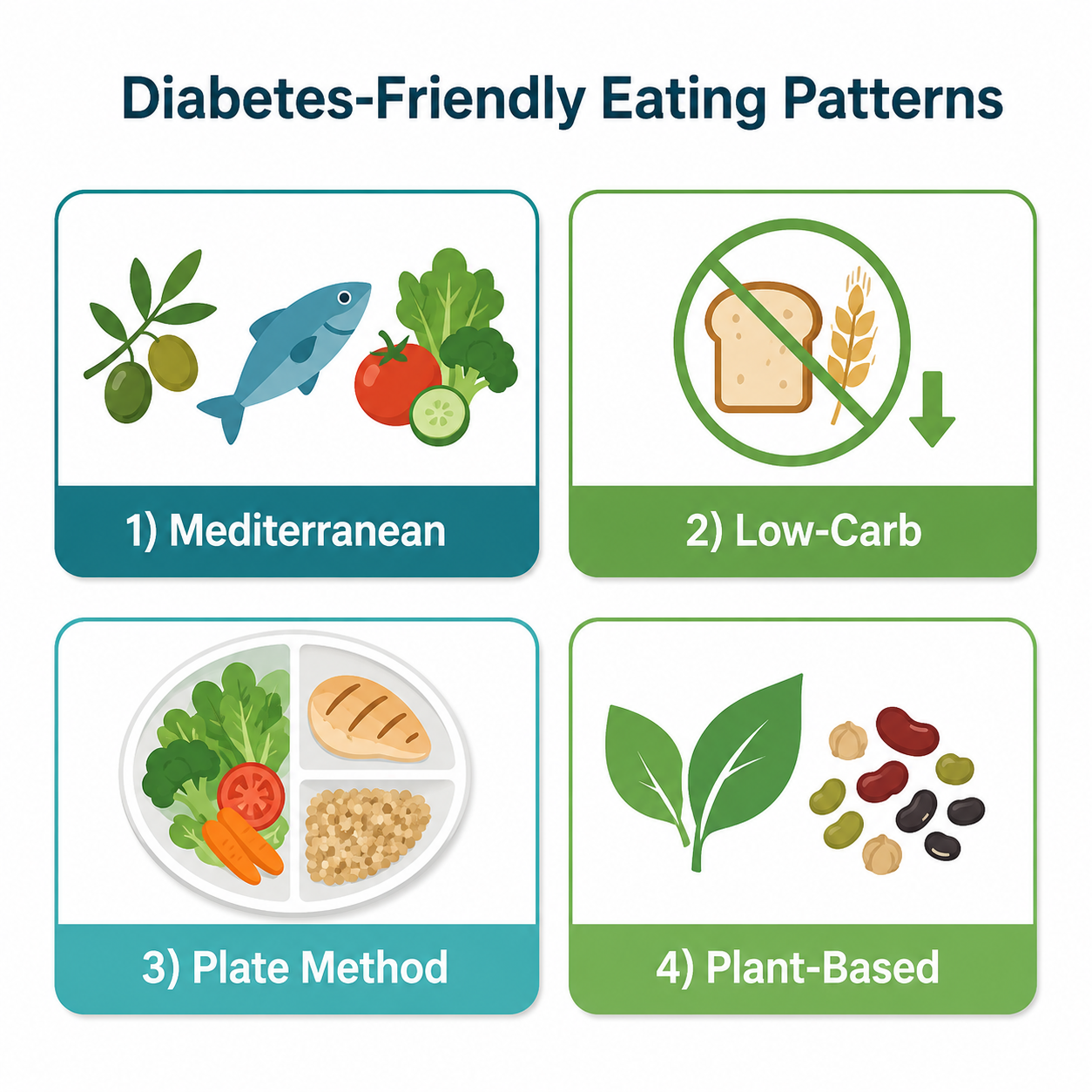
The ADA does not prescribe a single diet for all people with diabetes. The 2026 Standards highlight Mediterranean-style and low-carbohydrate patterns among the best-supported options, while also recognizing DASH, plant-based, and other individualized approaches as evidence-based choices. The best one for you depends on your preferences, type of diabetes, other health conditions, and what you can realistically sustain. Working with a Registered Dietitian Nutritionist is the best way to find your fit.
The table below summarizes the major evidence-based eating patterns. Use it as a starting point for a conversation with your dietitian, not as a prescription.
| Eating Pattern | Key Approach | Good if your main goal is… | Important Considerations |
|---|---|---|---|
| Mediterranean | High in vegetables, fish, olive oil, nuts, legumes; moderate whole grains; limited red meat and processed foods | Reducing cardiovascular risk, improving overall glucose control, and finding a sustainable long-term approach | Flexible and widely studied; one of the most practical patterns for long-term adoption |
| Low-carbohydrate | Reduces carbohydrates to roughly 26–45% of total calories; increases fat and protein | Lowering A1c, reducing triglycerides, raising HDL, or losing weight | May require medication adjustment if using insulin or sulfonylureas; work with your care team before starting |
| Very low-carbohydrate / ketogenic | Reduces carbohydrates further, with fat becoming the primary fuel source | Short-term weight loss and tighter blood sugar control in motivated individuals | Needs close medical supervision, particularly for people using insulin or an SGLT2 inhibitor, where medication adjustment and ketoacidosis risk can become concerns |
| DASH | Emphasizes fruits, vegetables, low-fat dairy, whole grains, and lean protein; limits sodium, saturated fat, and added sugar | Lowering blood pressure alongside blood sugar management | Well-suited when hypertension is a concern alongside diabetes |
| Plant-based / vegetarian | Centers on vegetables, fruits, legumes, whole grains, nuts; may include some animal products | Reducing cardiovascular risk and incorporating more fiber and plant protein | Requires attention to complete protein sources and B12 intake |
| Plate method | Visual tool: half the plate non-starchy vegetables, quarter lean protein, quarter quality carbohydrate | Simplifying portion control without counting | Good starting framework for newly diagnosed readers; can be adapted to any of the patterns above |

ADA 2026 note: The ADA 2026 Standards highlight Mediterranean-style and low-carbohydrate patterns among the best-supported options, while also recognizing DASH, plant-based, and other individualized eating patterns as evidence-based choices. Neither is mandated — the right pattern is the one you can sustain while meeting your blood sugar and health goals.
What About Carbohydrate Counting?
Carbohydrate counting is one of the most widely used practical tools in diabetes nutrition management, particularly for people using insulin. Because carbohydrates have the most direct impact on blood sugar, tracking the amount of carbohydrates in each meal allows you to better predict how your blood sugar will respond and, if you use insulin, to match your dose to what you eat.
You do not need to count carbohydrates to manage diabetes well, but understanding which foods are high in carbohydrates and roughly how much you are eating at each meal is valuable regardless of whether you formally count. Our guides on how to count carbohydrates, how many carbohydrates you need each day, and the glycemic index — a measure of how quickly different foods raise blood sugar — can help you develop this fluency.
For people using fixed insulin doses, the ADA 2026 Standards recommend consistency in the amount and timing of carbohydrate intake to reduce blood sugar variability and minimize low blood sugar risk. Your dietitian or diabetes educator can help you find the right balance for your situation.
How Do You Build a Personalized Eating Plan?
Nutrition for diabetes is not one-size-fits-all, and it should not be. Your eating plan needs to account for your type of diabetes, your medications, your weight goals, your cultural food preferences, your budget, and dozens of other factors. This is why the ADA 2026 Standards recommend working with a Registered Dietitian Nutritionist (RDN) — ideally one with diabetes experience — to develop your personalized plan. Medical nutrition therapy (MNT) with an RDN is covered by Medicare and most insurance plans when referred by a physician for diabetes management.
If you have not yet had a formal nutrition consultation, ask your doctor or diabetes educator for a referral. In the meantime, the following questions are worth bringing to that conversation:
- What is my target carbohydrate range per meal and per day?
- How should my eating plan account for my specific medications or insulin regimen?
- What eating pattern would you recommend based on my goals and health profile?
- How should I adjust what I eat around exercise?
- Are there foods I should prioritize or limit given my kidney function, blood pressure, or cholesterol levels?
Explore our full Food & Nutrition section:
→ Understanding carbohydrates and blood sugar
→ How many carbohydrates do you need each day?
Helpful Resources and Research
- ADA Standards of Care 2026 — Section 5: Facilitating Positive Health Behaviors
- ADA — Eating Patterns and Meal Planning
- NIDDK — Diabetes Diet, Eating, and Physical Activity
- DiabetesNet — Full Food & Nutrition Section
Frequently Asked Questions
Last Updated on May 13, 2026