
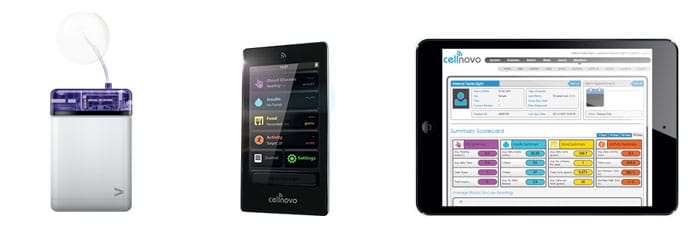
The Cellnovo insulin pump was an early semi-patch pump: a small pump stuck to the skin, paired with a touchscreen controller that sent your data to your care team automatically. It was sold in the UK, parts of Europe and a few other countries in the 2010s. Cellnovo stopped making and selling the system in March 2019, and a court opened liquidation proceedings against the company in May 2019.
This historical article explains how the Cellnovo pump worked, why the company failed and what its story means for people choosing a pump today.
Skip to Frequently Asked Questions
Cellnovo at a Glance
- Status: Discontinued. Manufacturing and sales stopped March 28, 2019. No support, parts or supplies are available.
- Type: Semi-patch pump — a small body-worn pump connected to a nearby insertion site by short tubing.
- Where it was sold: UK and several European countries, plus Australia, New Zealand, Israel, Greece and Cyprus through distributors.
- U.S. status: Never cleared by the FDA and never sold in the United States.
- Systems sold: About 1,500 from launch through the end of 2018, according to the company.
- Need a pump now? Compare current options in our insulin pump comparison and our guide to insulin pumps and automated insulin delivery systems.
What made Cellnovo different from other insulin pumps?
Most pumps of the time were clipped to clothing, with long tubing to the body. Cellnovo’s pump stuck to your skin and connected to a nearby insertion site through a short 1.5-inch infusion set. You could disconnect it at any time or wear it on longer tubing like a conventional pump.
The pump came in two parts. The reusable part held the electronics and a rechargeable battery, and you received two so one could charge while you wore the other. The disposable part was a 150-unit insulin cartridge that had to be replaced after 72 hours of use. That differs from the Omnipod, where the whole pod, electronics included, is thrown away.
The small cartridge was a real trade-off. If you use 50 units a day or less, a cartridge lasts the full three days. At 75 units a day it lasts about two days, and at 100 units a day about a day and a half, before counting insulin used for priming. The system was designed mainly for type 1 diabetes, and the small cartridge made it harder to use for people with high insulin needs, including many with type 2 diabetes. Refillable cartridges arrived in February 2019, weeks before the company closed.
How did Cellnovo deliver insulin?
Most traditional insulin pumps use a small electric motor to advance a plunger and deliver insulin. Cellnovo used a different approach: a tiny wax actuator that expanded when heated and contracted as it cooled.
Each heating cycle moved a small amount of insulin through a system of miniature valves. Long-acting (basal) insulin was delivered in pulses of 0.05 units. At a basal rate of 1 unit per hour, the pump delivered about one pulse every three minutes. Mealtime (bolus) doses used a combination of 0.1-unit and 0.05-unit pulses.
This design helped keep the pump compact, but it had limits. Bolus insulin was delivered at about 1 unit per minute, so a 10-unit meal dose took about 10 minutes, slower than many conventional pumps.
What safety and connectivity features did it offer?
Delivery monitoring and alarms
Cellnovo included a sensor that monitored changes in the insulin reservoir to help detect delivery errors. Like other pumps, it could not directly confirm that every programmed dose reached the tissue beneath the skin. Other safety features included:
- Alarms for under-delivery, over-delivery and blockages (occlusions).
- Automatic disconnection of the cartridge if over-delivery was detected. A released cartridge could not be put back in.
- A temperature alarm, because insulin breaks down when it gets too warm.
- An ID chip that blocked reuse of faulty cartridges and use of non-Cellnovo cartridges.
Although these features improved monitoring, they could not detect every problem immediately. The pump needed to miss roughly a unit of insulin before an occlusion alarm sounded, so at low basal rates a blockage could go unnoticed for hours. Users still needed to respond promptly to alarms and to unexpected high blood sugar readings.
Two generations of controllers
Cellnovo experimented with connected diabetes care years before smartphone-controlled pumps became common, using two generations of controllers:
- Original handset: A dedicated touchscreen device with a built-in blood sugar meter, food library and activity log fed by a motion sensor in the pump. Its own cellular connection uploaded data automatically to the Cellnovo Online portal, where your care team could view it with your permission.
- Third-generation controller (2018): A locked-down Android smartphone that talked to the pump over Bluetooth Low Energy. It was a dedicated controller only. You could not install a Cellnovo app on your own phone.
Why did Cellnovo shut down in 2019?
Cellnovo could not make and sell enough systems to cover its costs. Limited cartridge production held back sales until large-scale manufacturing began in June 2018, and the company also faced strong competition and pricing pressure.
On March 28, 2019, Cellnovo announced it would stop all manufacturing and sales immediately, and its UK operating company entered administration. Liquidation followed: the parent company filed with a Paris court on April 26, 2019, and the court opened liquidation proceedings on May 9, 2019. No buyer came forward.
Was Cellnovo ever available in the United States?
No. Cellnovo filed for FDA clearance in 2016 and answered follow-up questions from the agency, and the company expected approval in 2018. Clearance never came before the company closed, so the pump was never sold in the U.S.
Did Cellnovo contribute to automated insulin delivery?
Yes. Cellnovo was involved in several early automated insulin delivery projects. In these systems, an algorithm adjusts insulin automatically based on readings from a continuous glucose monitor (CGM). Cellnovo worked with TypeZero and Diabeloop and took part in the EU-funded PEPPER decision-support project.
The Diabeloop collaboration was the most important. In Diabeloop’s 12-week pivotal trial, investigators combined the Cellnovo pump with the DBLG1 algorithm and a Dexcom G5 CGM. Sixty-eight adults with type 1 diabetes were randomized. With the automated system, they spent 68.5% of the time in the target range of 70–180 mg/dL (3.9–10.0 mmol/L), compared with 59.4% when using the same pump and CGM without the algorithm.
Cellnovo’s closure ended its pump’s commercial future, and Diabeloop went on to market DBLG1 with other pumps, including the Kaleido. But the research showed that a small, body-worn pump could work inside an automated system, even though Cellnovo’s own system never became a commercial automated product. To see how today’s systems compare, read our comparison of automated insulin delivery systems.
How does Cellnovo compare with modern patch pumps?
“Patch pump” is used loosely, so it helps to separate three types of wearable insulin delivery:
| Category | How it works | Examples |
|---|---|---|
| Tubeless patch pumps | Pump and cannula are built into one body-worn unit | Omnipod 5, Mint, Mobi Tubeless |
| Semi-patch pumps | Small body-worn pump with short tubing to a nearby site | Cellnovo, Kaleido, Mobi worn on body |
| Mealtime-only patches | Deliver bolus insulin only, no continuous basal | CeQur Simplicity |
As of November 2026, the Omnipod 5 is the main tubeless patch pump available in the U.S. Beta Bionics’ Mint was FDA-cleared in September 2026, with launch planned for early 2027. Tandem’s Mobi Tubeless and MiniMed’s Fit are under FDA review, and Roche’s Accu-Chek Solo, FDA-cleared in 2023, has not launched in the U.S. For devices available today, see our insulin pump comparison.
What lessons did Cellnovo leave behind?
- Connected diabetes management. Cellnovo combined insulin dosing, glucose readings, activity data and remote data sharing years before these features became common.
- Modular hardware. Its reusable electronics and disposable insulin cartridge resemble design approaches used in several newer pumps, such as the Accu-Chek Solo and Mint, though there is no documented direct link between them.
- Reliable supply matters. Good technology is not enough on its own. Manufacturing capacity, insurance coverage, financial stability and access to supplies all affect the people who depend on a pump.
Some of Cellnovo’s safety choices also had costs. The required cartridge change every 72 hours and frequent alarms could be inconvenient, and clinical reviewers noted these usability trade-offs at the time.
Cellnovo was not alone: the Asante Snap maker closed in 2015, and Animas left the U.S. pump market in 2017. When you choose a pump, it is reasonable to ask about long-term support and supplies.
What should you do if you still have Cellnovo equipment?
Never rely on an unsupported insulin pump for ongoing treatment. Cellnovo no longer provides service, replacement parts, cartridges or data access, and any remaining supplies are long expired.
- If you are changing pumps, work with your diabetes care team on a safe transition plan, with backup insulin pens or syringes on hand.
- Avoid any gap in insulin. Pumps use only rapid-acting insulin, so an interruption can raise your blood sugar within hours and lead to diabetic ketoacidosis (DKA), a dangerous buildup of acids in the blood, especially in type 1 diabetes.
- Your old basal rates, carbohydrate ratios and correction factors are useful background, but new settings should be reviewed for the replacement system. Many current automated insulin delivery systems use adaptive algorithms.
- Watch for signs of low blood sugar and high blood sugar while you adjust.
Helpful Resources & Research
- Bain SC. The Cellnovo Insulin Delivery System (2017) — technical specifications, delivery monitoring and safety features.
- Patch Pumps for Insulin. Journal of Diabetes Science and Technology (2018) — Cellnovo design, wax mechanism and limitations.
- Heinemann L, et al. Patch Pumps: Are They All the Same? Journal of Diabetes Science and Technology (2018) — independent overview of patch pump designs.
- Diabeloop WP7 pivotal trial of the DBLG1 system (NCT02987556), author manuscript — Cellnovo pump in automated insulin delivery research.
- Cellnovo announces liquidation proceedings, May 9, 2019 (regulatory filing)
- Beta Bionics Mint receives FDA clearance — MedTech Dive (September 2026)
- MiniMed submits Fit patch pump for FDA clearance — MedTech Dive (2026)
- American Diabetes Association Standards of Care in Diabetes — see Section 7, Diabetes Technology.
Frequently Asked Questions
Is the Cellnovo insulin pump still available?
No. Cellnovo stopped making and selling its pump system in March 2019, and the company was placed in liquidation in May 2019. Pumps, cartridges and technical support are no longer available anywhere.
Why was the Cellnovo pump discontinued?
The company could not produce enough cartridges or sell enough systems to cover its costs amid strong competition. When it ran out of money in 2019, no buyer stepped in.
Was the Cellnovo pump ever FDA-approved?
No. Cellnovo applied for FDA clearance in 2016 and expected approval in 2018, but it closed before clearance was granted. The pump was never sold in the United States.
Was Cellnovo a patch pump?
It was a semi-patch pump. The pump stuck to your skin, but it connected to a nearby insertion site through a short 1.5-inch infusion set instead of having a built-in cannula like the Omnipod.
How much insulin did a Cellnovo cartridge hold?
Each disposable cartridge held 150 units and had to be replaced after 72 hours of use. People using more than about 50 units a day needed to change cartridges more often.
How was Cellnovo different from today’s patch pumps?
Cellnovo used a wax actuator instead of a motor, delivered boluses slowly (about 1 unit per minute) and worked only with its own dedicated controller. Many current systems adjust insulin automatically using a CGM, and several run on your own smartphone.
Was the Cellnovo pump used in automated insulin delivery?
Yes, in research. In a 12-week trial, Diabeloop’s DBLG1 algorithm running with the Cellnovo pump and a Dexcom CGM increased time in range compared with the pump and CGM alone. Cellnovo closed before an automated version reached the market.
What should I do if I am switching from a discontinued pump?
Work with your diabetes care team on a transition plan so there is no gap in insulin delivery, and keep backup pens or syringes on hand. Your old settings are a useful starting point, but they should be reviewed for the new pump.
Medical Disclaimer: This article is for general information and historical reference only and is not medical advice. Talk with your healthcare provider before making any changes to your insulin delivery or diabetes treatment plan.
Last Updated on November 12, 2026