
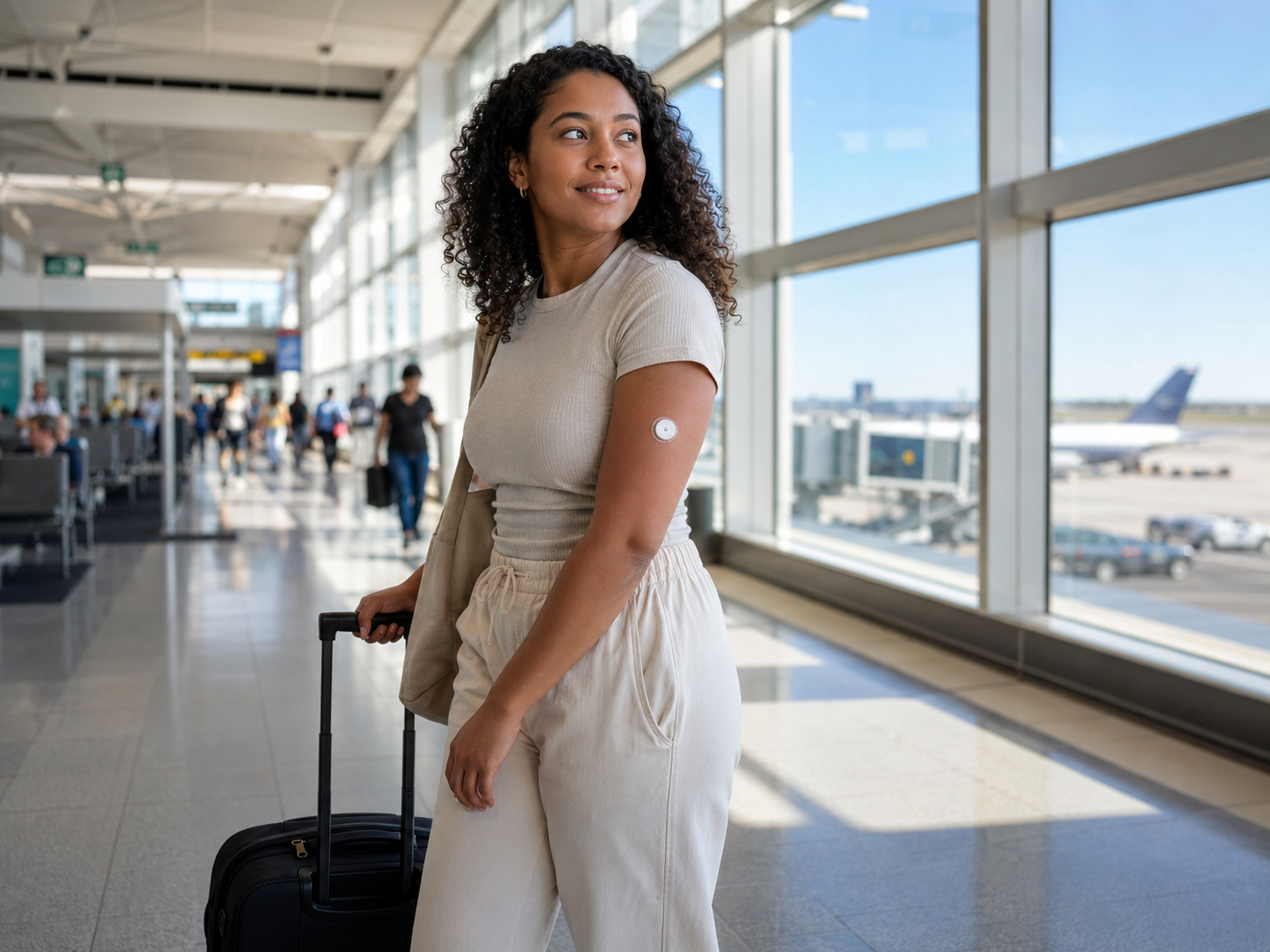
 Air travel with diabetes requires a bit of extra planning, but with the right preparation, you can fly confidently — insulin pump, CGM, and all. Whether you’re heading across the country or crossing multiple time zones, knowing the current TSA rules and how to manage your blood sugar in the air makes every trip smoother. This guide covers everything: what you can bring through security, how to handle your devices at the checkpoint, what to do in flight, and how to adjust insulin when your travel day spans time zones.
Jump to: Frequently Asked Questions
✈️ Quick Reference: What Diabetes Travelers Need to Know
- TSA allows: All insulin (vials, pens, pumps), syringes, CGMs, lancets, glucagon, and juice or gels for low blood sugar — even in amounts over 3.4 oz.
- Declare at security: Inform the TSA officer about your diabetes supplies before screening begins.
- Devices: Notify the TSA officer before screening if you wear an insulin pump or CGM. Screening options vary by device — ask for the screening method your manufacturer recommends.
- Keep: your insulin, CGM sensors, pumps, and other supplies in your carry-on or personal item — never in checked luggage.
- Pack double: Bring twice as many supplies as you think you’ll need, split between your carry-on and personal item.
- Time zones: Crossing 2 or fewer time zones? You may not need to adjust insulin — but check with your care team based on your regimen.
What should I do before leaving home?
A little preparation before departure prevents most travel-day headaches. Work through this checklist in the week before your flight:
- Download or print your device manufacturer’s airport screening guidance. Many manufacturers (Tandem, Dexcom, Abbott, Insulet, Medtronic) publish specific instructions for airport security screening. Having this on your phone or in print helps if a TSA officer is unfamiliar with your device.
- Pack twice the supplies you expect to need. Delays happen. Bags get lost. Travel days run long.
- Split your supplies between your carry-on and personal item. If your carry-on is unexpectedly gate-checked, you’ll still have what you need at your seat.
- Bring prescriptions or pharmacy labels. Not required by TSA, but they can speed up screening if you’re selected for additional inspection.
- Set phone alarms for medication times. It’s easy to lose track of insulin schedules when you’re moving through airports and across time zones.
- Check charger and plug compatibility for international travel. Pump and CGM chargers may require an adapter or a voltage converter abroad.
- Call TSA Cares at least 72 hours before travel if you’d like assistance at the checkpoint. Phone: 1-855-787-2227. TSA Cares can arrange for a Passenger Support Specialist to meet you at your departure airport.
- Discuss time zone adjustments with your diabetes care team. This is especially important if you’re crossing multiple time zones or using long-acting insulin, NPH, or a fixed schedule.
What can I bring through TSA with diabetes?
TSA allows all diabetes supplies through security checkpoints. People with diabetes are specifically exempt from the standard 3.4-ounce liquid rule for medically necessary items.
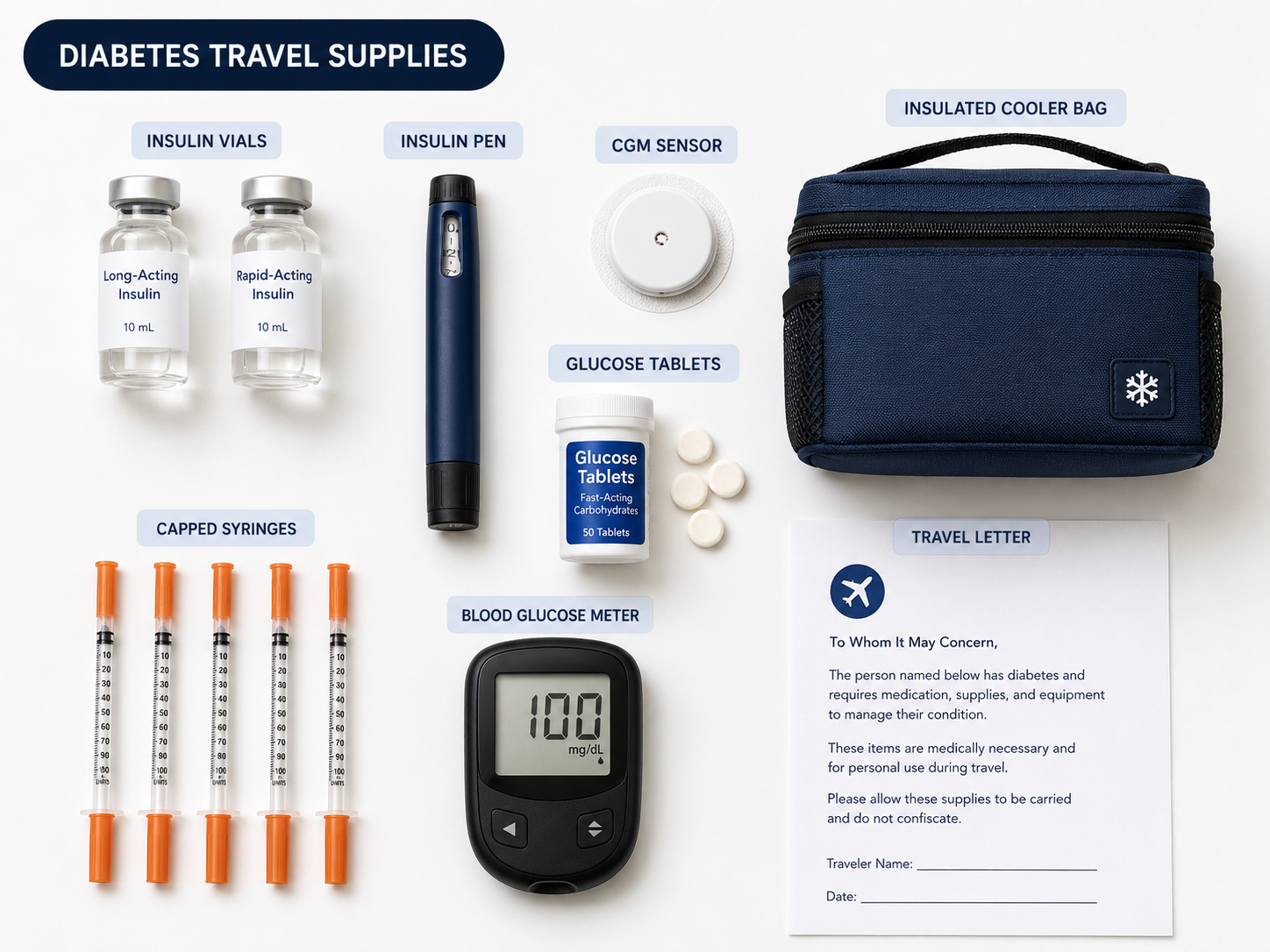
Here’s what you can bring in your carry-on:
- Insulin — in any form (vials, insulin pens, pre-filled syringes, or loaded into your pump)
- Unused and used syringes (used ones must be in a sharps disposal container)
- Insulin pumps and all pump supplies (tubing, infusion sets, pods, batteries, cartridges)
- Continuous glucose monitors (CGMs) — sensors, transmitters, receivers, and chargers
- Lancets and blood glucose meter with test strips
- Glucagon emergency kit (injection or nasal spray)
- Fast-acting carbohydrates: juice boxes, glucose tablets, gels, or hard candy — even in containers larger than 3.4 oz
- Ice packs or frozen gel packs to keep insulin cool
- Ketone strips
If you use a GLP-1 medication or another injectable (such as semaglutide or tirzepatide), TSA permits these as well. Check your medication’s storage instructions before travel — many unopened pens require refrigeration, while other pens that are opened or in use may be kept at room temperature for a limited time. Confirm the specific limits for your brand.
Tip: While TSA doesn’t require a prescription, carrying one — or a letter from your doctor — can speed up screening if you’re selected for additional inspection. Keep medications in their original pharmacy-labeled containers whenever possible.
How do I get through airport security with an insulin pump or CGM?
Before screening begins, notify the TSA officer that you wear an insulin pump or CGM. You can do this verbally or by showing a TSA Disability Notification Card (available at no cost on the TSA website).
Scanner guidance varies for pump and CGM devices
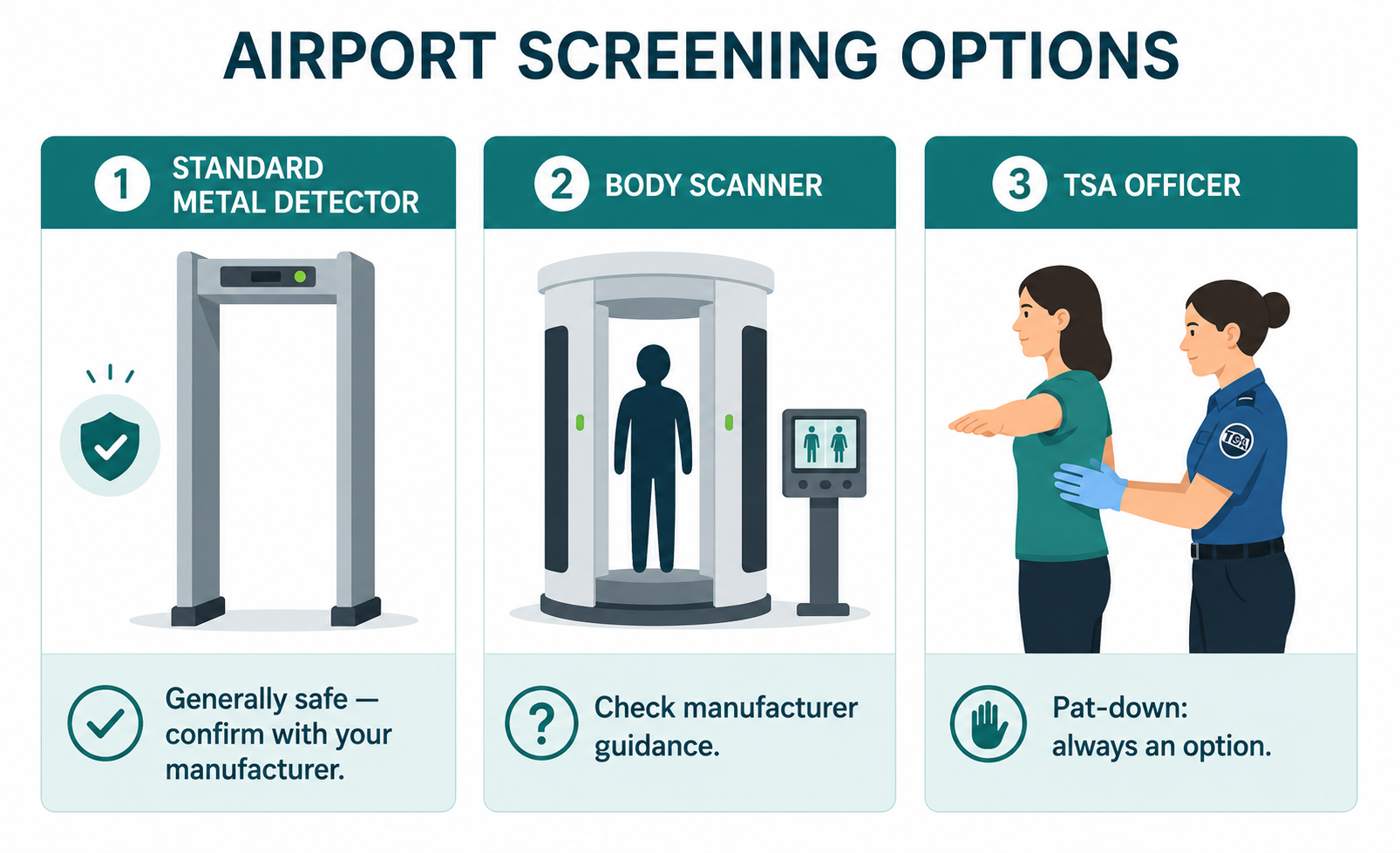
Device screening recommendations vary by manufacturer, so there is no single rule that applies to all pumps and CGMs. Before your trip, consult the specific guidance for your device. As a general approach:
- Tell the TSA officer what you’re wearing and ask for the screening method recommended by your device manufacturer. TSA does not have a blanket policy for all pumps and CGMs.
- Many tubed pumps and some CGMs should not go through full-body scanners or the baggage X-ray belt. Tandem’s pumps, for example, should not go through baggage X-ray machines or full-body scanners, but are safe through metal detectors. Abbott’s FreeStyle Libre sensors should avoid full-body scanners that use millimeter-wave technology.
- Some patch-pump systems have different guidelines. Insulet’s Omnipod devices, for example, can safely pass through airport X-ray machines and scanners. Check your specific system’s instructions.
- You may request a pat-down instead of using imaging technology. If body scanners are the only option available and your device manufacturer advises against them, a pat-down is an acceptable alternative. You may also request that this be done in a private screening area.
X-ray machines and hand inspection
Many insulin pumps and CGMs should not be placed on the baggage X-ray belt — but this is not universal. Check your manufacturer’s instructions. If your device maker advises avoiding X-ray, request a hand inspection before screening begins. The TSA officer can visually inspect your device and supplies instead.
You may ask whether a standard metal detector is available. If so, it is often the simplest option for most insulin pumps. If only a body scanner is available at that checkpoint, you may request a pat-down instead.
Should I pack my diabetes supplies in checked luggage?
No — this rule is absolute for insulin. Checked baggage is stored in the aircraft hold, where temperatures can reach extremes (both very cold and very hot) during flight. These temperature swings can damage or destroy insulin, CGM sensors, and other supplies.
Key rule: Always keep your insulin and diabetes supplies in your carry-on bag or personal item — never in your checked luggage.
One smart strategy: split your supplies between your carry-on and your personal item (backpack, fanny pack, or purse). If your carry-on is unexpectedly gate-checked, you’ll still have a day or two of supplies with you in the cabin.
Essential Diabetes Travel Packing Checklist
| Medication | Monitoring | Device Supplies | Emergency Items |
|---|---|---|---|
| Insulin (all types) | CGM sensors + transmitter | Pump tubing / infusion sets | Glucagon kit (injection or nasal) |
| Insulin pens or vials | CGM receiver + charger | Pump batteries or charger | Fast-acting glucose (tabs, gels, juice) |
| Syringes (extra) | Blood glucose meter | Extra pods (if OmniPod) | Ketone strips |
| GLP-1 or other injectables | Test strips + lancets | Adhesive tape / skin prep | Medical ID bracelet |
| Cool pack for insulin | Phone with CGM app | Pump cartridges / reservoirs | Doctor’s letter + prescriptions |
How can I manage my blood sugar during the flight?
Air travel disrupts your normal routine — meal timing shifts, you’re more sedentary than usual, and stress hormones can raise your blood sugar. Here’s how to stay in range:
Monitoring in-flight
- Check your blood sugar more often than at home. During a long flight, every 4 to 6 hours is recommended. If you feel symptoms of low or high blood sugar, check right away.
- If your CGM or AID system uses Bluetooth: Turn on airplane mode first, then re-enable Bluetooth if the airline allows it and your device instructions permit. Without Bluetooth, you may lose CGM readings, alarms, or automated insulin adjustments, depending on your system. Basal insulin delivery typically continues, but automated corrections and alerts may not.
- If you use an automated insulin delivery (AID) system, notify the airline before your flight, if possible. Your system should continue working normally in flight, but confirm this with your care team before departure.
Food and insulin timing
- Don’t inject insulin until your meal is in front of you. Airline meals are sometimes delayed. If you pre-dose and the cart doesn’t reach you, you could experience low blood sugar.
- Keep fast-acting carbs within easy reach — at your seat, not in the overhead bin. You may not be able to reach overhead bins during turbulence.
- Stay hydrated with water. Cabin air is very dry, and dehydration can raise blood sugar. Limit alcohol and caffeine, both of which can affect blood sugar.
Moving around and circulation
Long periods of sitting increase the risk of blood clots, especially during long flights. Diabetes and related conditions may further increase that risk for some people, so walking the aisle every 1–2 hours is a smart precaution. Pointing and flexing your feet while seated also helps circulation.
Altitude and insulin pumps
Altitude changes during a flight can affect how much insulin your pump delivers, causing slight over- or under-delivery in some cases. This is rarely a significant issue on commercial flights, but it’s worth monitoring more closely on long-haul trips if you notice unexpected highs or lows.
How do I adjust insulin when crossing time zones?
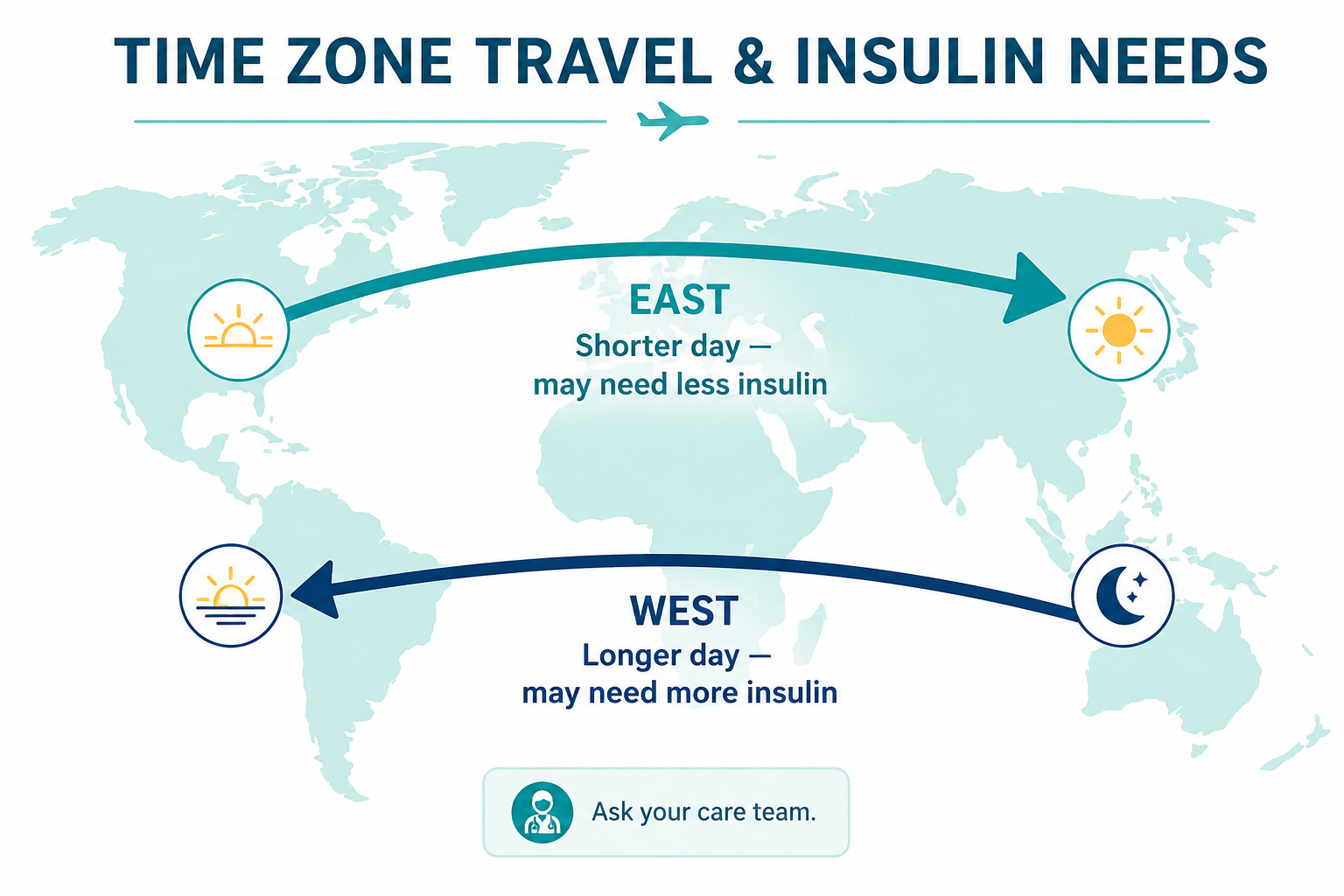
For many travelers, time zone changes cause more anxiety than the flight itself. The adjustments needed — if any — depend heavily on your insulin type and regimen. Remember that extra airport walking with luggage and changes in air pressure during a flight may also affect your blood sugar and carbohydrate needs. Discuss your travel route with your diabetes care team before any long-distance trip.
| Time Zone Change | General Guidance |
|---|---|
| Fewer than 3 time zones | Many people need little or no adjustment, especially those using an insulin pump or a flexible basal-bolus regimen. People on long-acting insulin, NPH, or a fixed schedule should ask their care team for individualized instructions. |
| 3–5 time zones | Minor adjustments may help. Discuss your specific route and regimen with your care team before traveling. |
| More than 5 time zones | Plan with your doctor or diabetes educator. Specific dose adjustments are generally recommended and depend on your regimen and direction of travel. |
Eastward travel (shorter day)
Traveling east shortens your day. Insulin doses may come closer together than usual, increasing your risk of low blood sugar. As a general rule, you may need slightly less insulin on an eastward travel day. Follow local time for dosing starting the morning after you arrive.
Westward travel (longer day)
Traveling west lengthens your day. If you take injections, your dose may need to be slightly higher to cover the extra hours. If you cross a significant number of time zones going west, you may need an extra meal — and the insulin to go with it.
Insulin pump and AID system users
Many pump users keep their pump set to home time while traveling and update it to local time after arrival. However, the best timing depends on your route, basal pattern, and AID system — time changes can affect basal profiles, correction targets, and automated algorithm behavior. Ask your diabetes care team when to change the pump clock, especially when crossing several time zones.
On travel day, it’s generally safer to allow your blood sugar to run slightly higher than your normal target to reduce the risk of low blood sugar during travel disruptions and increased activity.
⚠️ Talk to your diabetes care team at least a few weeks before any long-distance trip. Time zone adjustments are highly individual. Don’t figure this out alone on the day of your flight.
What should I do if I have low blood sugar on the plane?
Low blood sugar during a flight is manageable if you’re prepared. Always keep fast-acting carbohydrates at your seat, not in the overhead bin.
If you feel symptoms of a low:
- Treat immediately: 15–20 grams of fast-acting carbs — such as 4 glucose tablets, a small juice box, or a gel pack.
- Wait 15 minutes, then recheck your blood sugar. Repeat if it remains low.
- Inform the flight crew if you need help. Flight attendants are trained to assist with medical situations. If you use glucagon, ensure a travel companion knows how to use it before you board.
If your blood sugar is high (hyperglycemia), drink plenty of water and correct it with insulin as directed by your care plan.
How do I travel internationally with diabetes?
International travel introduces a few additional considerations beyond domestic flights:
- Research your destination’s rules: TSA rules apply within the U.S., but other countries have their own airport security policies. Check in advance, especially for needles and liquid medications.
- Carry a travel letter from your doctor: A signed letter on official letterhead explaining your diagnosis and the supplies you carry is strongly recommended and may be required in some countries.
- Know insulin concentrations: The U.S. standard is U-100 insulin. Some countries sell U-40 insulin. If you refill your insulin abroad, make sure your syringe matches the insulin concentration to avoid dangerous dosing errors.
- Before you leave, identify local emergency resources: Research emergency numbers, nearby hospitals, and how to contact your insulin pump or CGM manufacturer while abroad. Your diabetes care team may be able to suggest destination-specific resources.
- Consider travel insurance: Medical travel insurance can cover emergency care, lost medication, and unexpected delays. Some policies cover pre-existing conditions, such as diabetes.
How do I store insulin safely while traveling?
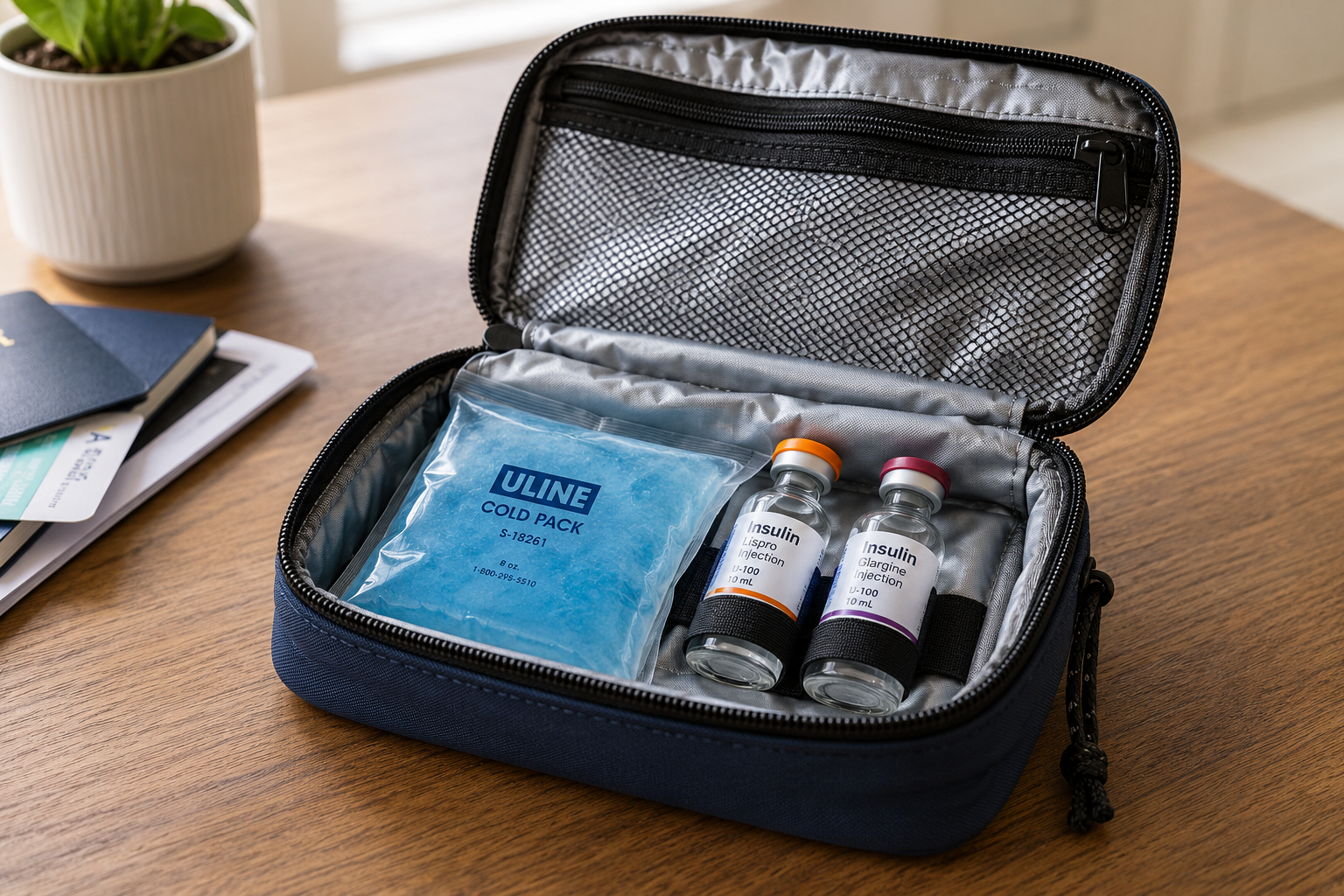
Insulin is sensitive to both heat and extreme cold. Exposure to high temperatures or freezing temperatures can make insulin less effective or inactive.
| Situation | What to Do |
|---|---|
| Short trip | Many opened insulin vials and pens can be kept at room temperature for about 28 days, but limits vary by brand and formulation. Check the package insert for your specific insulin and keep it out of direct sunlight and away from heat sources. |
| Hot climate or long trip | Use an insulated travel case with a gel pack. Avoid direct ice contact — frozen insulin is damaged insulin. |
| In-flight storage | Keep insulin in the cabin with you at your seat or under the seat in front. Avoid the overhead bin, which can get cold on some flights. |
| Checked baggage | Never. Cargo holds can reach freezing temperatures or extreme heat during flight. |
After travel: Always inspect your insulin before injecting. Cloudy insulin that is normally clear, or insulin that has changed color, may be damaged. When in doubt, don’t inject — contact your care team.
Helpful Resources & Research
The following sources were consulted to verify the information in this article and may be useful to readers seeking more guidance:
- American Diabetes Association: What Can I Bring on a Plane?
- ADA: What Special Concerns May Arise at Airport Security?
- TSA: Insulin Pumps and Glucose Monitors
- CDC: Tips for Traveling with Diabetes
- US Pharmacist: Traveling with Diabetes (2025)
- Johns Hopkins Medicine: Traveling with Diabetes
- TSA Cares Helpline: 1-855-787-2227 (available 72 hours before travel, Mon–Fri 8 a.m.–11 p.m. ET; weekends 9 a.m.–11 p.m. ET)
Frequently Asked Questions
Can I bring my insulin and syringes through airport security checkpoints?
Yes. TSA allows all diabetes supplies through security, including insulin, syringes, lancets, and glucagon. Medically necessary liquids — such as insulin or juice for low blood sugar — are exempt from the standard 3.4-ounce rule, even in larger containers. Declare them to the TSA officer before screening begins.
Can I wear my insulin pump or CGM through the airport security scanner?
Screening recommendations vary by device, so there is no single rule that applies to everyone. Before screening, tell the TSA officer that you’re wearing a device and ask for the method your manufacturer recommends. Many tubed pumps should avoid body scanners, while some patch-pump systems can go through both scanners and X-ray machines. You may request a pat-down as an alternative to imaging.
Should I pack my diabetes supplies in checked luggage?
No. Always keep insulin, CGM sensors, pumps, and other supplies in your carry-on or personal item. Cargo hold temperatures can destroy insulin and damage electronics. Split your supplies between your carry-on and personal item so you have a backup if your carry-on is gate-checked.
How often should I check my blood sugar during a flight?
Wearing a CGM, whether prescribed or over-the-counter, is always your best option when traveling. Plan to check every 4 to 6 hours during a long flight, or whenever you notice symptoms of low or high blood sugar. Travel disrupts your routine — meal timing shifts, you’re less active, and stress can affect your levels in either direction. More frequent monitoring keeps you in control.
Do I need to adjust my insulin when crossing time zones?
It depends on your regimen and how many time zones you’re crossing. Many pump users or those on flexible basal-bolus regimens need little to no adjustment for short crossings. People using long-acting insulin or on fixed schedules should get individualized guidance from their care team before any trip that crosses more than 2 or 3 time zones.
What if I run out of insulin while traveling abroad?
Carry at least twice as many supplies as you expect to need. If you need a refill abroad, note that insulin concentrations vary by country — the U.S. standard is U-100, while some countries use U-40. If you use a different concentration, you’ll also need syringes that match. Your doctor can provide a prescription to take to a pharmacy abroad.
Can I bring glucagon on a plane?
Yes. Glucagon — in an injection kit or nasal spray — is permitted by TSA in your carry-on. If you travel with glucagon, make sure a travel companion knows how to use it before you board. Keep it at your seat, not in the overhead bin, so it’s accessible quickly if needed.
Is it safe to let my insulin go through the X-ray machine?
Under most circumstances, insulin can safely pass through X-ray machines. If you prefer not to X-ray your insulin, you can request a hand inspection before screening begins. Many insulin pump and CGM manufacturers advise against placing their devices in baggage X-ray machines — always check your device’s specific instructions and request a hand inspection if recommended.
What is the TSA Cares helpline and how can it help?
TSA Cares (1-855-787-2227) is a helpline for travelers with disabilities and medical conditions, including diabetes. Call at least 72 hours before your flight to discuss your supplies, ask about screening procedures, or request a Passenger Support Specialist to meet you at the checkpoint. Hours are Monday–Friday, 8 a.m.–11 p.m. ET, and weekends, 9 a.m.–11 p.m. ET.
How can I keep my insulin cool during a long trip?
Many opened insulin vials and pens remain stable at room temperature for about 28 days, though this varies by brand and formulation — check the package insert for your specific insulin. For long trips or in hot climates, use an insulated travel case with a gel pack. Avoid direct contact with ice, which can freeze and damage insulin. Never store insulin in the cargo hold.
Last Updated on May 19, 2026