
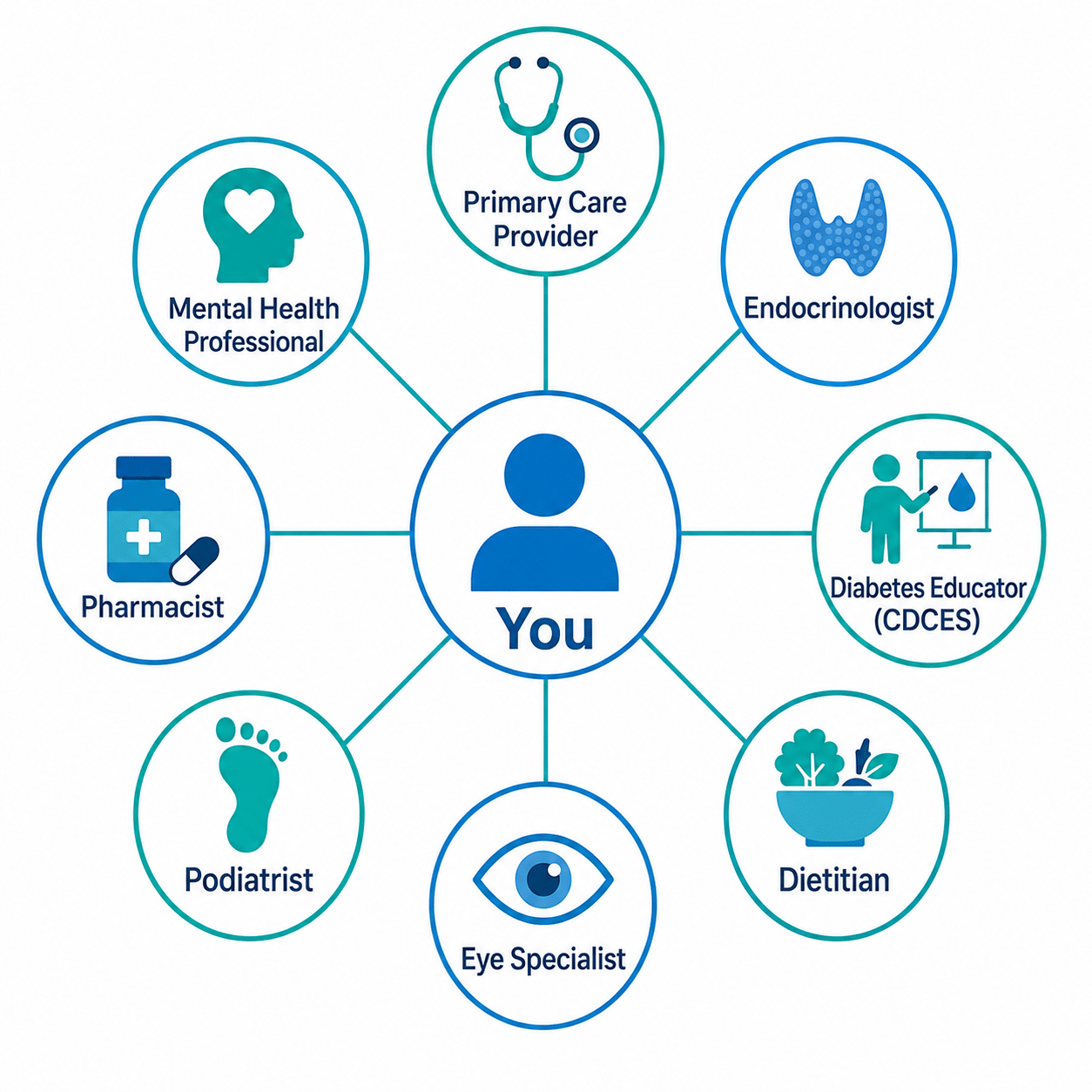
Managing diabetes well is not something you have to do alone, and no one person can do it for you either. Good diabetes management is a partnership — between you and a team of professionals, each bringing specific expertise to the table. Understanding who should be on your diabetes care team, what each person does, and what good routine care looks like will help you get more from every appointment and make better decisions between visits.
Quick overview: Your diabetes care team typically starts with a primary care provider and may grow to include an endocrinologist, a certified diabetes care and education specialist (CDCES), a registered dietitian nutritionist, and other specialists depending on your situation. The ADA 2026 Standards recommend diabetes self-management education and support (DSMES) for all people with diabetes at diagnosis and at key points throughout care.
Read on for who does what, what tests and checkups to expect, and how to make the most of your doctor visits.
Jump to: Frequently Asked Questions ↓
Why You Are the Most Important Member of Your Care Team
Every diabetes care team has one member who matters more than all the others combined: you. Your doctors can prescribe medications and order tests, but only you can take your medication, check your blood sugar, adjust your food choices, exercise, and make the dozens of small decisions each day that determine how well your diabetes is managed.
The most effective diabetes management happens when you are an active, informed participant rather than a passive recipient of instructions. That means asking questions, sharing what is and is not working, and being honest with your care team about the challenges you face. No good care team will judge you for struggling — they will work with you to find approaches that fit your life.
Your family members and close friends can also play a meaningful supportive role. Having someone who understands your diabetes — what low blood sugar looks like, which foods affect you, and how to help in an emergency — can make a real difference. Consider asking one trusted person to be your diabetes partner: someone you can talk things through with and whose perspective you value when considering changes to your management.
Who Should Be on Your Diabetes Care Team?
Your care team will vary depending on your type of diabetes, how long you have had it, and any other health conditions you have. Here is an overview of the professionals you are most likely to work with and what each one does.
Primary care provider
Your primary care provider (PCP) — whether a physician, physician assistant, or nurse practitioner — is usually your first point of contact for diabetes management and general health. They will monitor your blood sugar, order routine lab work, manage your medications, and coordinate referrals to specialists. If your diabetes is well controlled and uncomplicated, your PCP may manage it entirely. If it is more complex — particularly with Type 1, insulin-dependent Type 2, or developing complications — they will likely refer you to an endocrinologist.
Endocrinologist
An endocrinologist is a physician who specializes in hormone-related conditions, including diabetes. Endocrinologists are particularly valuable for people with Type 1 diabetes, those whose blood sugar is difficult to control with standard treatment, those managing complex insulin regimens, and those dealing with complications or other hormone-related conditions alongside diabetes. Not everyone with diabetes needs to see an endocrinologist, but you should ask your PCP for a referral if your management is not going well.
Certified Diabetes Care and Education Specialist (CDCES)
A Certified Diabetes Care and Education Specialist (CDCES) — previously called a Certified Diabetes Educator (CDE) — specializes in teaching people with diabetes to manage their condition day to day. They help you understand how to check your blood sugar, use insulin or other medications correctly, interpret your readings, and adjust your routine for exercise, illness, and travel. The ADA 2026 Standards recommend Diabetes Self-Management Education and Support (DSMES) for all people with diabetes at diagnosis, annually thereafter, when complications develop, and when goals are not being met. Ask your doctor for a DSMES referral — it is covered by most insurance plans and by Medicare.
Registered Dietitian Nutritionist (RDN)
A Registered Dietitian Nutritionist helps you develop an eating plan that supports blood sugar control while fitting your lifestyle and nutritional needs. Your dietitian can help with carbohydrate counting, meal planning, reading food labels, and weight management. The ADA 2026 Standards recommend medical nutrition therapy with an RDN for all people with prediabetes or diabetes.
Mental health professional
Living with a chronic condition carries an emotional burden that healthcare teams often underestimate. Anxiety, depression, and diabetes distress — the specific emotional burden of managing a relentless condition — are common and directly affect self-care and outcomes. The ADA 2026 Standards recommend annual screening for anxiety, depression, and diabetes distress in all people with diabetes, with referral to a behavioral health professional when concerns are not adequately addressed during routine visits. A social worker, psychologist, therapist, or licensed counselor can provide meaningful support — not just for coping, but for problem-solving practical challenges related to finances, insurance, relationships, and daily management.
Eye care specialist
Diabetes can damage the blood vessels in the retina, leading to diabetic retinopathy, which can progress to vision loss without symptoms in its early stages. Early detection is essential. Most adults with diabetes need a dilated eye exam at diagnosis or soon after — timing depends on diabetes type — and then generally every year thereafter. Some people with well-controlled diabetes and no evidence of retinopathy may be able to extend exams to every 1–2 years, based on their eye doctor’s assessment. Make sure your eye care provider is experienced in evaluating and treating diabetic eye disease. See our guide to eye complications for more details.
Podiatrist
A podiatrist specializes in the care of the feet and lower legs. People with diabetes can develop nerve damage (neuropathy) and reduced circulation in the feet, which can lead to slow-healing wounds and serious complications. A podiatrist can screen for early signs of neuropathy and circulatory problems, treat foot conditions before they become serious, and advise on proper footwear. A comprehensive foot exam is recommended at least once a year.
 Pharmacist

Your pharmacist is a valuable, often underused member of your diabetes team. They can answer questions about your medications, flag potential interactions, advise on medication timing, and support adherence. Try to fill all your prescriptions at the same pharmacy, so your pharmacist has a complete picture of everything you take.
Other specialists
Depending on your individual health situation, your care team may also include:
- Cardiologist: Cardiovascular disease is significantly more common among people with diabetes. A cardiologist may be involved if you have or are at high risk of heart disease, heart failure, or stroke.
- Nephrologist: A kidney specialist may be involved if you develop chronic kidney disease (CKD), a common complication of long-standing diabetes. Early detection through annual urine and blood tests is essential.
- Physician assistant or nurse practitioner: PAs and NPs work alongside physicians and are fully qualified to manage diabetes evaluation and care. Your everyday diabetes management may be primarily with a PA or an NP.
- Exercise physiologist: Physical activity is one of the most effective ways to manage blood sugar and overall health. An exercise physiologist can help design a safe program tailored to your fitness level and any complications.
- Dentist: People with diabetes face a higher risk of gum disease, and gum disease in turn can make blood sugar harder to control. Visit your dentist at least twice a year and always inform them that you have diabetes.
- Home caregiver: If you need help managing your diabetes at home, it is important to find a caregiver experienced in diabetes management — someone trained to recognize signs of high and low blood sugar and to maintain contact with your care team.
What Does Good Diabetes Care Look Like?
Beyond knowing who is on your team, it helps to understand the rhythm of routine diabetes care — what tests to expect, how often to get them, and what is checked at each visit.
What should be reviewed at every visit?
Each time you see your primary care provider or endocrinologist, the following should be reviewed:
- Blood pressure — many adults with diabetes are treated toward a goal below 130/80 mm Hg if it can be reached safely, but targets are individualized based on cardiovascular risk and overall health
- Weight and body mass index (BMI)
- Blood sugar readings from your meter or CGM log
- Review of current medications and any recent changes
- Discussion of diet, physical activity, and any concerns since your last visit
- Foot check — ask about foot symptoms at every visit; perform a visual foot inspection at each visit for high-risk patients (those with sensory loss, prior ulceration, or circulation problems); perform a comprehensive foot exam at least annually for all people with diabetes
Which lab tests do most adults with diabetes need?
The following tests are part of standard diabetes care for most adults. Your schedule may be adjusted based on how well your diabetes is controlled and on whether complications are present.
| Test | Type | Frequency | What It Measures |
|---|---|---|---|
| A1c (HbA1c) | Blood | Every 3 months if not at goal; every 6 months if stable and well-controlled | Average blood sugar over the past ~3 months. General target: below 7% for most adults, individualized based on your situation |
| Lipid panel (cholesterol) | Blood (fasting) | Annually, or as needed based on treatment | LDL goals are individualized; many adults with diabetes are treated to below 100 mg/dL (2.6 mmol/L), with lower targets such as below 70 mg/dL (1.8 mmol/L) often used in higher-risk patients |
| Urine albumin (microalbumin) | Urine | Annually | Detects early kidney damage by measuring protein in urine |
| Serum creatinine / eGFR | Blood | Annually | Monitors kidney function; eGFR estimates filtration capacity |
The following tests are recommended in certain situations but are not routine for everyone with diabetes. Your doctor will determine whether and how often these apply to you.
| Test | When It Applies | What It Checks |
|---|---|---|
| Thyroid function (TSH) | Most relevant in Type 1 diabetes, in people with symptoms of thyroid disease, or when autoimmune conditions or other clinical factors raise concern. Routine repeated TSH testing is less universal in uncomplicated Type 2 diabetes. | Screens for thyroid disease, which is more common in people with diabetes, particularly Type 1 |
| 24-hour urine or creatinine clearance | As directed by your doctor if kidney disease is identified or progressing | Assesses kidney filtration capacity in more detail |
| Additional cardiovascular screening | Based on your individual cardiovascular risk profile, symptoms, and history | May include EKG, echocardiogram, or other tests as directed by your cardiologist or PCP |
 What annual exams should people with diabetes have?
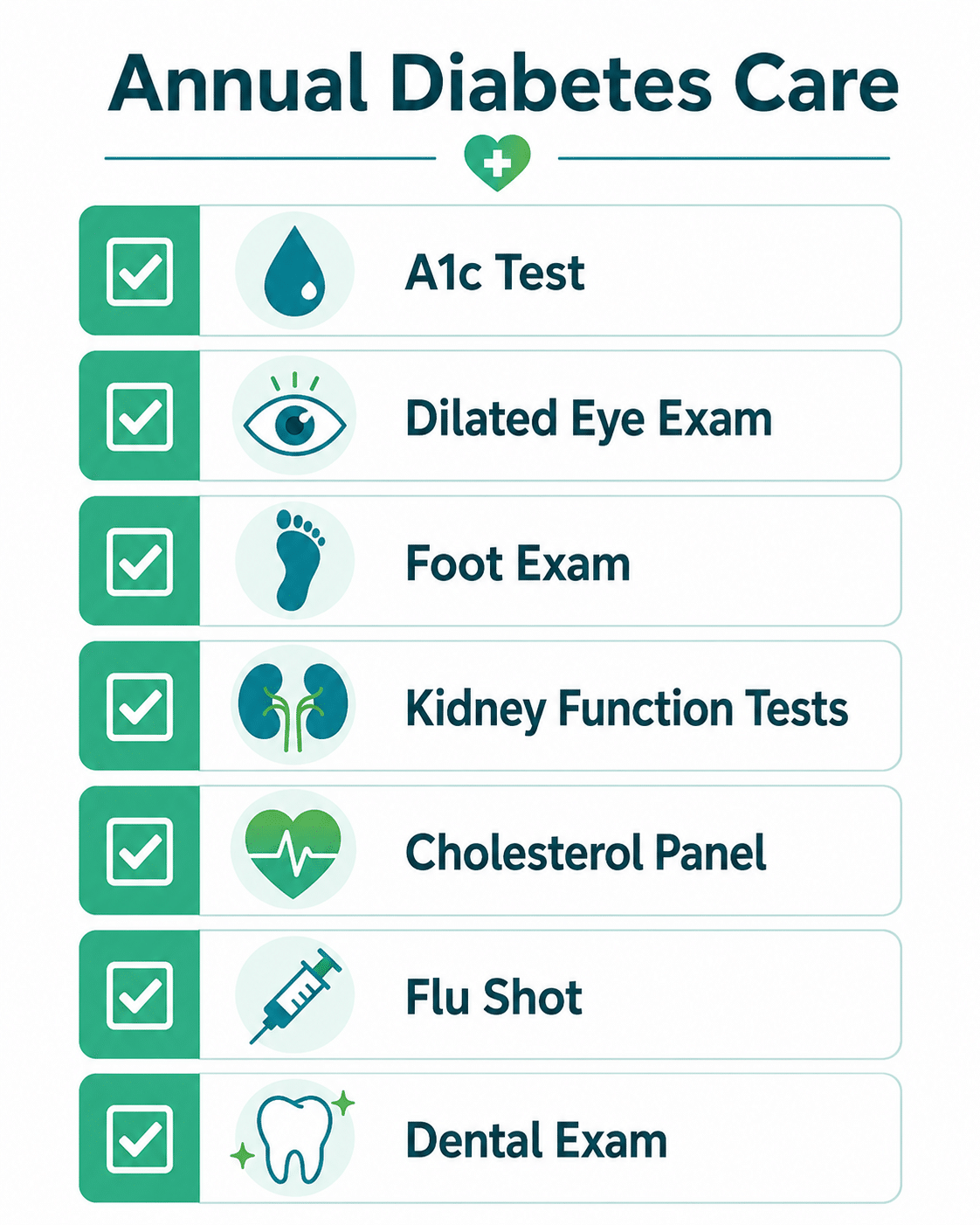
In addition to lab tests, the following should be scheduled on a regular basis:
- Dilated eye exam: Most adults need a dilated eye exam at diagnosis — timing varies by diabetes type — and generally every year thereafter. Some people with well-controlled diabetes and no retinopathy may be able to extend the interval to every 1–2 years, based on their eye doctor’s recommendation.
- Foot exam: A comprehensive foot exam is recommended at least once a year. For high-risk patients — those with nerve damage, prior wounds, or circulation problems — visual foot checks at each visit are also appropriate. Ask about foot symptoms at every appointment.
- Dental exam: At least twice a year. Inform your dentist about your diabetes.
- Blood pressure: Checked at every visit.
What vaccinations do people with diabetes need?
People with diabetes face a higher risk of serious illness from certain infections. The following are recommended by current CDC guidance:
- Influenza (flu): Every year. An annual flu vaccination is one of the most important preventive steps.
- Pneumococcal vaccine: Adults with diabetes ages 19–49 should receive a single dose of PCV20 or PCV21. At age 50, your doctor will review whether additional doses are needed. Note: the current CDC schedule has replaced the older PPSV23 (“Pneumovax”) approach — ask your doctor which vaccines you have already received.
- COVID-19: Stay up to date with the CDC’s current recommendations, which are updated regularly.
- Hepatitis B: Recommended for all adults through age 59. For adults 60 and older, hepatitis B vaccination is recommended for those with risk factors and may also be appropriate for others in this age group who want protection. Discuss your vaccination history with your doctor.
- Shingles (Zoster): Recommended for adults 50 and older, including those with diabetes. The two-dose recombinant zoster vaccine (Shingrix) is preferred.
- Tdap: Tetanus/diphtheria/pertussis booster if not previously received as an adult.
DSMES — Diabetes Self-Management Education and Support: The ADA 2026 Standards strongly recommend DSMES for all people with diabetes at four key times: at diagnosis, annually, when complications develop, and when treatment goals are not being met. DSMES is covered by Medicare and most insurance plans when referred by a physician. Ask your care team for a referral if you have not participated in a formal diabetes education program.
How Do You Talk to Your Doctor About Diabetes?
 Getting the most from your healthcare appointments requires preparation and active participation. Many people leave their doctor’s office without all the information they need — not because their doctor was unhelpful, but because appointments are short, topics are complex, and it can feel awkward to ask questions or push back. These strategies can help.
How to prepare before your appointment
- Write down your questions in advance. Start with the most important one in case time runs short.
- Bring your blood sugar log, CGM report, or phone app data. Your doctor can spot patterns in a summary report that would take much longer to discuss in person.
- Note any symptoms since your last visit — unusual highs or lows, changes in energy, foot or vision changes, or anything else that concerned you.
- Bring a complete list of all your medications, including over-the-counter medications and supplements.
- If possible, bring a trusted family member or friend. A second set of ears is helpful when you receive a lot of new information at once.
What questions are worth asking at a diabetes appointment?
- “Is my A1c where you want it to be? What is my current number, and what is the target?”
- “Are there any complications I should be screening for that we have not screened for recently?”
- “Are all my vaccinations up to date?”
- “I have been experiencing trouble with [specific issue]. What options do we have?”
- “Is a continuous glucose monitor (CGM) right for me?”
- “Should I see an endocrinologist or a diabetes educator?”
- “What should I do if my blood sugar goes above [X] or below [Y]?”
- “What would change in my care if I became pregnant or wanted to become pregnant?”
How do you advocate for yourself as a diabetes patient?
If something about your care does not feel right, it is appropriate to speak up. If a medication causes side effects, if your blood sugar is consistently out of range, or if you feel your concerns are being dismissed, you have the right to ask for an explanation, request a second opinion, or seek a different provider. Being a good patient does not mean being passive.
If your primary care provider is unfamiliar with current diabetes management approaches — including continuous glucose monitors, newer medication classes, or automated insulin delivery — requesting a referral to an endocrinologist is a reasonable step. See our full guide to insulin pumps and automated insulin delivery and continuous glucose monitors for information that may support more informed conversations with your care team.
Helpful Resources and Research
- ADA Standards of Care 2026 — Section 4: Comprehensive Medical Evaluation
- ADA Standards of Care 2026 — Section 5: Facilitating Behavior Change and Well-being
- ADCES — Find a Diabetes Care and Education Specialist
- CDC — National Diabetes Prevention Program
- ADA — Vaccinations for People with Diabetes
- DiabetesNet — Eye Complications of Diabetes
Frequently Asked Questions
Do I need to see an endocrinologist, or is my primary care doctor sufficient?
Many people with Type 2 diabetes manage well with a primary care provider, especially when blood sugar responds to treatment. An endocrinologist is particularly valuable for people with Type 1 diabetes, those on complex insulin regimens, or those whose blood sugar is difficult to control. If your primary care provider is not familiar with current diabetes management approaches, such as CGMs or newer medication classes, requesting an endocrinologist referral is a reasonable step.
What is a CDCES, and do I need to see one?
A CDCES — Certified Diabetes Care and Education Specialist — is trained to teach diabetes self-management skills including blood sugar monitoring, insulin technique, meal planning, and coping strategies. The ADA recommends working with a CDCES at diagnosis and at key transitions throughout your care. DSMES programs staffed by CDCESs are covered by Medicare Part B and most insurance plans when referred by a physician — ask your doctor for a referral.
How often should I have an A1c test?
The ADA 2026 Standards recommend A1c testing two to four times per year depending on how stable your blood sugar control is. If you are well controlled and stable, every six months is often sufficient. If you are newly diagnosed, adjusting medications, or not meeting your goals, testing every three months provides more timely feedback to guide treatment decisions.
What vaccinations do people with diabetes need?
Annual influenza vaccination is strongly recommended for all people with diabetes. A pneumococcal vaccine (PCV20 or PCV21 preferred) is recommended for adults with diabetes ages 19 and older. Hepatitis B vaccination is recommended for all adults through age 59 and for adults 60 and older with risk factors. Shingles vaccine (Shingrix, two-dose series) is recommended from age 50. COVID-19 vaccination should follow current CDC guidance. Ask your doctor to review your vaccination history to confirm you are up to date.
What should I bring to a diabetes appointment?
Bring your blood sugar log or CGM summary report, a complete list of all medications including supplements, a written list of questions or concerns, and notes on any symptoms or changes since your last visit. A trusted family member or friend can also help — a second set of ears is valuable when you receive a lot of new information. Starting your list with your most important question ensures it gets addressed even if time runs short.
What is DSMES and who should participate?
DSMES — Diabetes Self-Management Education and Support — is a structured, evidence-based program that teaches the practical and emotional skills needed to manage diabetes effectively, including blood sugar monitoring, medications, nutrition, exercise, and coping. The ADA recommends DSMES for all people with diabetes at diagnosis, annually, when complications develop, and when treatment goals are not being met. It is covered by Medicare and most insurance plans with a physician referral.
How often should I have a dilated eye exam?
Most adults with diabetes need a dilated eye exam at diagnosis — timing varies by diabetes type — and then generally every year thereafter. Some people with well-controlled diabetes and no evidence of retinopathy may be able to extend the interval to every 1–2 years based on their eye doctor’s assessment. Early detection of diabetic retinopathy, before symptoms appear, is the key reason annual exams are the standard recommendation.
Is dental care important if I have diabetes?
Yes — the relationship between diabetes and gum disease runs in both directions. Uncontrolled blood sugar increases the risk of gum disease, and untreated gum disease can make blood sugar harder to control. People with diabetes face a higher risk of periodontal disease, and gum infections can meaningfully affect glycemic control. Visiting a dentist at least twice a year and informing them of your diabetes diagnosis is a meaningful part of comprehensive diabetes management.
How do I find out if I need a kidney specialist?
Your primary care provider or endocrinologist screens for kidney disease with annual tests — urine albumin and serum creatinine/eGFR. If results show early signs of kidney disease, your doctor may manage it directly or refer you to a nephrologist. Getting these tests done every year is the most important step, as early detection allows interventions that can significantly slow the progression of diabetic kidney disease.
What should I do if my doctor is not listening to my concerns?
Start by being specific — write down your exact concerns and bring them as a written list to your next appointment. If concerns are consistently dismissed, it is appropriate to request a longer dedicated appointment, ask for a specialist referral, or seek a second opinion. A good care team treats you as a partner in your own management. If that is not your experience, it may be worth finding a different provider who will engage with you more collaboratively.
Last Updated on May 13, 2026
