
Keeping blood sugars normal is the best way to keep the eyes healthy. But to protect your vision, comprehensive eye exams are needed every year, or as directed by your physician. Remember, the most dangerous threats to vision in diabetes give little or no warning. Only by direct examination with an ophthalmoscope can these early changes be seen and treatment started before sight becomes seriously threatened.
Some physicians are excellent at examining the retina and spend the extra time required to visualize the entire retina. Others may not do this exam often enough in people with diabetes to feel comfortable identifying these changes in the retina. In a 1982 report, Dr. Elliot Sussman and others found that serious errors in examining the retina were made by 52% of internists, 33% of diabetologists, 9% of general ophthalmologists, while none were made by retina specialists.
Discuss with your own physician whether and when you need to see an ophthalmologist or retina specialist. Warning signs to indicate that treatment of the eye is needed may, at times, only be picked up by an experienced ophthalmologist.
Self-Testing The Eye
At times, someone who has diabetes can detect changes in their vision that warn of problems. These changes can be found using a simple Amsler grid. Testing with an Amsler grid helps to detect vision changes caused by poor control, macular edema, or a detached retina. The grid is used by health professionals to detect eye problems, but it only detects problems in the macula and cannot check other regions of the eye. Anyone who has been told they have significant eye changes caused by diabetes should test each eye daily. If you notice any changes in your vision, see your eye doctor immediately.
Instructions for the test using the Amsler grid:
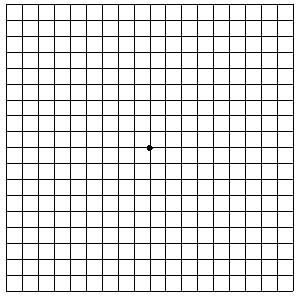
1. Print out the square to the left on white paper.
2. Wear your reading glasses and cover one eye.
3. Focus on the center dot for one full minute.
4. While looking directly at the center, be sure that all the lines are straight and clear, and all the small squares are the same size.
5. Repeat the test in the other eye.
6. If any lines or squares appear distorted, wavy, blurred, discolored, or otherwise abnormal, call your eye doctor right away.
7. In healthy eyes the lines are straight.
The Amsler grid will NOT detect PDR, most pre proliferative changes and other types of damage that may threaten vision, nor is it useful for detecting any of the early changes found in BDR. It cannot replace routine eye exams. Remember: a normal Amsler grid test does not rule out the presence of retinopathy that can threaten your vision. Only regular eye exams can do this.
Return to Home Page or visit the U.S. N.I.D.D.K. Site on Diabetic Eye Disease or the National Eye Institute for more information.